AI marketing has flattened a useful vocabulary into one buzzword. “AI-powered” can mean a decision tree, a fraud-scoring model, or a frontier LLM — and the differences matter for cost, risk, and what the technology can actually do. Here is the terminology map that survives a vendor pitch.
AI Is the Umbrella
Artificial intelligence is the whole field: systems performing tasks associated with human cognition — perception, language, reasoning, decisions. It includes techniques nobody calls AI anymore (rule-based expert systems, classical ML). Almost everything marketed as AI today is machine learning, and most of that is deep learning — models trained on data rather than hand-coded rules.
Generative AI Creates; Predictive AI Scores
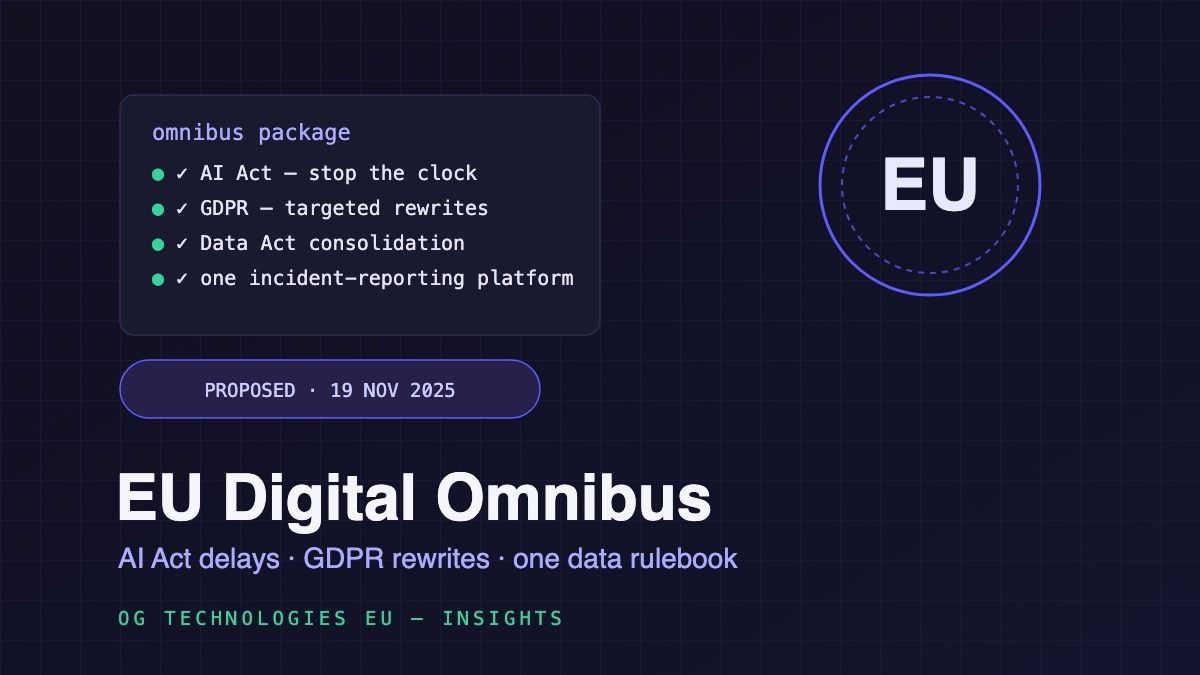
Generative AI is the subset that produces new content — text, code, images, audio — by modeling the statistical structure of training data and sampling from it. The contrast is predictive AI: fraud probability, churn risk, demand forecasts. Most enterprise value today pairs the two — a generative interface over predictive models and retrieval systems — and the EU AI Act already imposes specific transparency duties on generative systems.
LLMs Are the Text Engine of GenAI
A large language model is a Transformer trained on massive text corpora to predict the next token — a simple objective that generalizes into instruction following, reasoning, and code generation at scale. LLMs are the dominant generative architecture for language tasks; image and video generation run on different families (diffusion). When a product says “AI assistant,” an LLM is almost always underneath.
Inference Is Where the Money Goes
Inference — running the trained model on your input — is the recurring cost paid on every request. Training is a one-off capital expense; inference is unit economics. Every generated token costs a forward pass, which is why API pricing is per-token, why smaller specialist models and distillation matter commercially, and why the hosted-vs-self-hosted decision is really an inference-cost decision. Reasoning models trade more inference (thinking tokens) for better answers.
AGI Is a Governance Term, Not a Product
AGI — artificial general intelligence — means human-level capability across essentially all domains. Every deployed system is narrow AI: strong inside its training distribution, helpless outside it. No consensus test exists, lab definitions differ, and regulation deliberately avoids the label — the AI Act regulates general-purpose AI by capability and compute thresholds, not by declaring AGI achieved.
The 2026 Model Landscape
The families that matter, and what differentiates them:
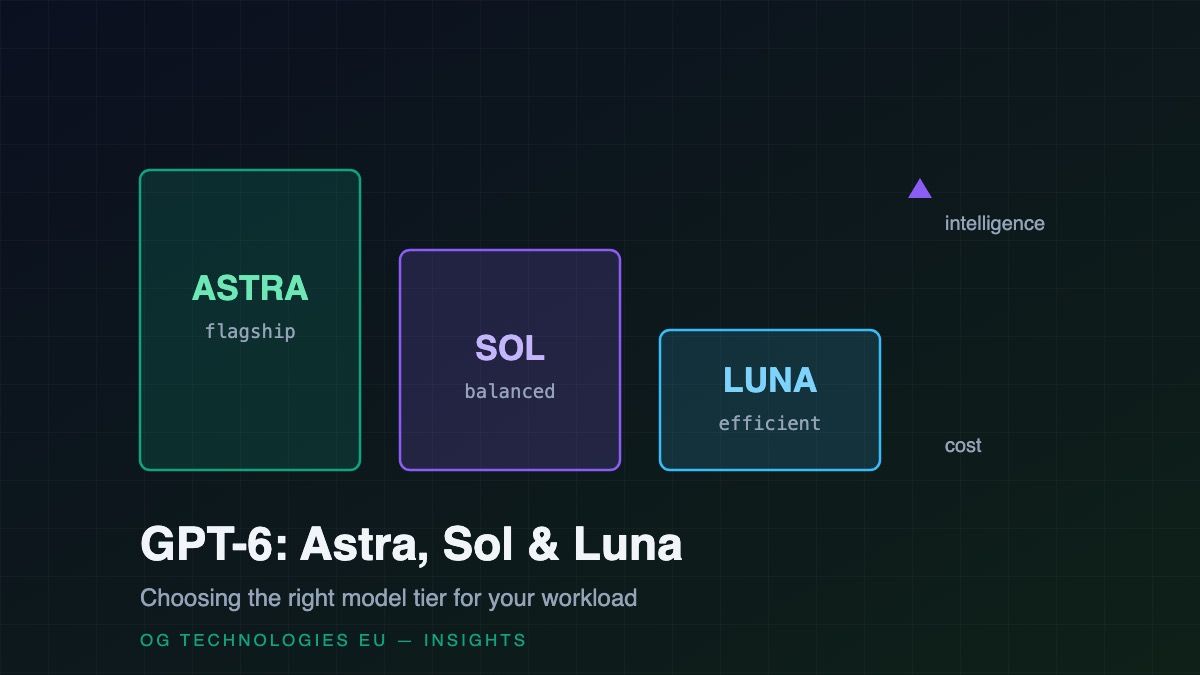
- GPT (OpenAI) — the frontier API incumbents; GPT-6 ships Astra/Sol/Luna tiers trading reasoning depth for speed and price. See our tier guide.
- Claude (Anthropic) — Opus/Sonnet/Haiku tiers, long context, and the strongest agentic-coding story via Claude Code and MCP. See our enterprise workflow guide.
- Gemini (Google DeepMind) — natively multimodal, wired into Workspace and the Argon/Antigravity agentic tooling. See our deep dive.
- DeepSeek, Kimi, GLM — the open-weight tier: near-frontier performance, self-hostable, radically cheaper inference at scale. Coverage: DeepSeek V4, Kimi K3, GLM-5.
- Devin (Cognition) — the delegation end of the spectrum: an agentic engineer that takes tasks end-to-end rather than completing prompts. See our analysis.
The Buying Frame
Cut through the label with four questions: what does it do (generate, predict, or act), where does inference run (hosted API or your infrastructure), what does a unit of work cost, and which obligations attach (AI Act tiers, data residency, ISO 42001 governance). Answer those and the buzzword collapses into an architecture decision — the same frame we use for AI features inside CRM systems.
Frequently Asked Questions
What is the difference between AI and generative AI?
AI is the umbrella field — any system performing human-associated cognitive tasks. Generative AI is the subset that creates new content (text, code, images); the rest of AI is predictive or analytical — scoring, forecasting, ranking.
Is an LLM the same thing as AI?
No — an LLM is one model type inside AI: a Transformer trained on text to predict tokens. AI also covers vision systems, recommendation engines, classical ML, and rule-based systems. Most “AI” products people use today are LLMs, but the terms are not interchangeable.
What is AI inference?
Inference is running a trained model on new input to get output — every chatbot reply, every completion. It is the recurring per-request cost of AI, versus the one-off training cost — which is why it drives API pricing and self-hosting decisions.
Does AGI exist?
No deployed system is AGI — human-level capability across all domains. Today’s frontier models are narrow AI with impressive breadth inside their distribution. Regulation like the AI Act sidesteps the label entirely and regulates by capability and compute thresholds.
Should we use a hosted model or self-host an open-weight one?
Hosted APIs (GPT, Claude, Gemini) win on frontier capability and zero ops; open-weight models (DeepSeek, Kimi, GLM) win on data control, predictable unit cost, and no vendor lock-in — at the price of running the stack. Most enterprises end up with both: frontier for hard reasoning, open-weight for high-volume tasks.