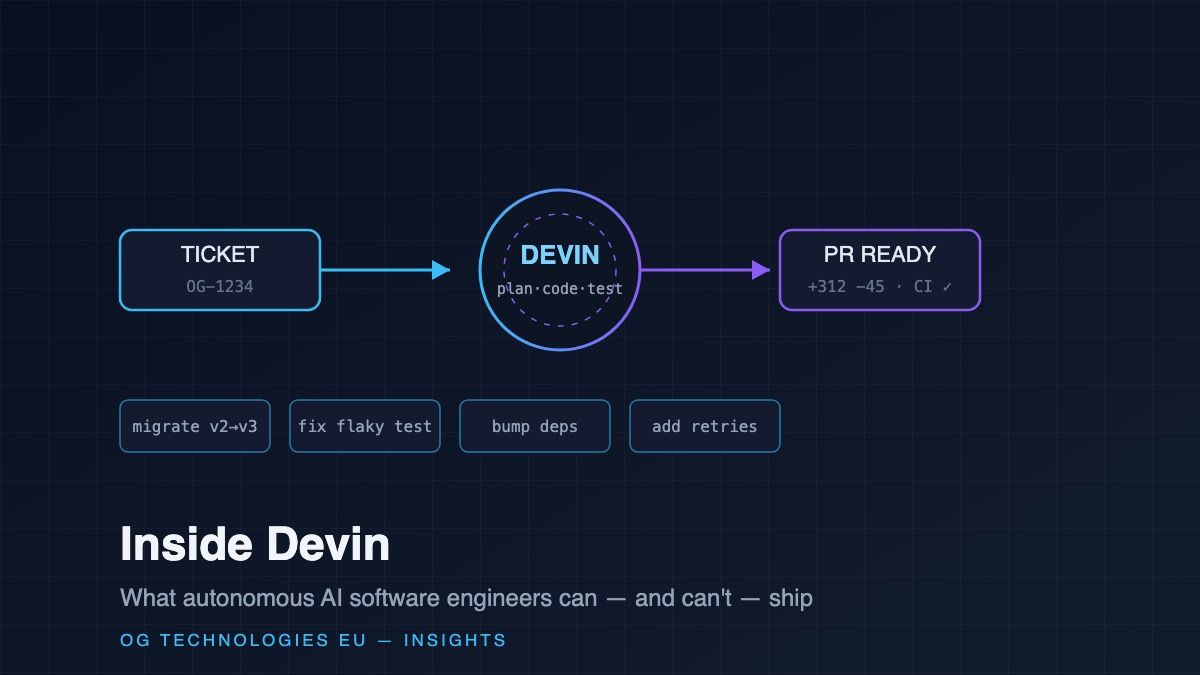
Devin, built by Cognition AI, occupies a different category from coding assistants: it is an autonomous software engineer that takes a task — a ticket, a bug report, a migration request — and works it asynchronously to a finished pull request. Rather than sitting beside you in an editor suggesting lines, it operates its own environment: shell, editor, browser, and test runner, working the way a remote engineer would.
Two years into production deployments — and after Cognition's acquisition of Windsurf brought the agentic IDE side of the workflow in-house — the pattern of where Devin creates real leverage is well established. So is the pattern of where it doesn't. This article is an honest evaluation of both.
How It Works: Ticket to Pull Request
The canonical workflow looks like this:
- Assign a task — from an issue tracker, Slack, or the Devin interface, with a description and ideally acceptance criteria.
- Devin plans — it explores the repository, identifies affected files, and writes a step-by-step plan you can inspect and redirect before execution.
- It executes in its own environment — editing code, installing dependencies, running builds and tests, browsing documentation, and self-correcting on failures.
- It delivers a PR — with a summary of what changed and why, test results, and a session replay you can audit step by step.
Because sessions run asynchronously, a team can queue several tasks in parallel — Devin works through them while engineers stay on the work that needs human judgment. The unit of work management shifts from "what am I typing next" to "what is the backlog, and which items are agent-shaped?"
Where It Excels
- Mechanical-but-long work: dependency upgrades, API migrations, framework version bumps, codemods across many files — tasks that are tedious for humans but well-specified.
- Well-reproduced bugs: a failing test or a clear repro gives the agent a verification signal it can iterate against until green.
- Test and coverage work: writing unit tests, expanding coverage on legacy modules, fixing flaky tests.
- First drafts at scale: scaffolding new services, boilerplate CRUD, documentation generation — output that a human then reviews and shapes.
- Backlog drain: the long tail of small, real improvements nobody prioritizes — the agent's throughput is genuinely unmatched here.
Where Humans Still Lead
- Ambiguous product work: "make onboarding better" is not an agent task. Agents need verifiable goals; product judgment is not delegable.
- Novel architecture: greenfield system design, cross-service trade-offs, and decisions driven by business context the agent can't see.
- Deep-context debugging: production incidents involving distributed state, tribal knowledge, or systems outside the repo.
- Subtle correctness domains: consensus code, financial rounding, security-critical paths — where "looks right" and "is right" diverge and verification is hardest.
- Review itself: every agent PR needs a human merge decision. Review throughput becomes the bottleneck as agent throughput grows.
The honest summary: Devin is strongest as a parallel junior-to-mid engineer with infinite stamina and no context-switching cost, and weakest wherever the task is really a judgment call wearing a task's clothing.
Deploying It Well
Teams that get sustained value follow a consistent playbook:
- Curate the queue. Write tickets with acceptance criteria and reproduction steps the way you would for a contractor — because that is the operating model.
- Invest in repo hygiene. Clear build/test commands, lint configs, and a good README are the agent's equivalent of CLAUDE.md-style context; they directly determine success rate.
- Scope credentials tightly. The agent gets the repo and environment access it needs — nothing more. Least privilege applies to non-human engineers exactly as it does to humans.
- Keep the review gate. PR review by a human stays mandatory; measure review time, since it becomes the pacing constraint on agent throughput.
- Measure acceptance, not volume. Track PR merge rate and rework — "tasks attempted" is a vanity metric.
Governance Considerations
An autonomous engineer commits code under an identity — decide up front how commits are attributed, how its access is provisioned and revoked, and how its activity is logged for audit. Under an AI management system, the deployment gets the same treatment as any AI system: inventory entry, risk assessment, accountable owner. Our ISO/IEC 42001 guide and the free ISO 42001 AI Readiness Assessment are a practical starting point.
Frequently Asked Questions
Is Devin the same as a coding copilot?
No. Copilots assist line-by-line inside your editor session. Devin takes whole tasks and executes them asynchronously in its own environment, returning a pull request rather than suggestions.
How good is it on benchmarks?
Devin made its name on SWE-bench-style tasks — real GitHub issues resolved end-to-end. Benchmarks understate what matters operationally: success rate on your backlog, which depends on ticket quality and repo hygiene more than on the model.
What tasks should we assign first?
Dependency upgrades, test coverage gaps, and small well-specified bugs — bounded work with a clear verification signal. Avoid ambiguous feature work until you've calibrated on easy wins.
Does it remove the need for code review?
No — it increases review demand. Every task ends in a PR, and the human merge decision stays mandatory. Plan for review capacity; it becomes the real throughput limit.