On September 10, 2026, DeepSeek released V4.1 Flash — a 552-billion-parameter mixture-of-experts model under the MIT license, with a 1M-token context window, up to 384K output tokens, and native image input. Vendor benchmarks claim it beats the previous flagship; independent measurements put it in a statistical tie with Kimi K3 at the top of the open-weight field — at roughly 1/40th the cost per agent task.
That combination — frontier-adjacent capability, unrestricted license, and radical cost efficiency — is why DeepSeek keeps setting the price floor for the entire industry. For teams running agentic workloads, where a single task can burn millions of tokens in tool-call loops, the economics matter more than the benchmark headlines.
What MoE Actually Buys You
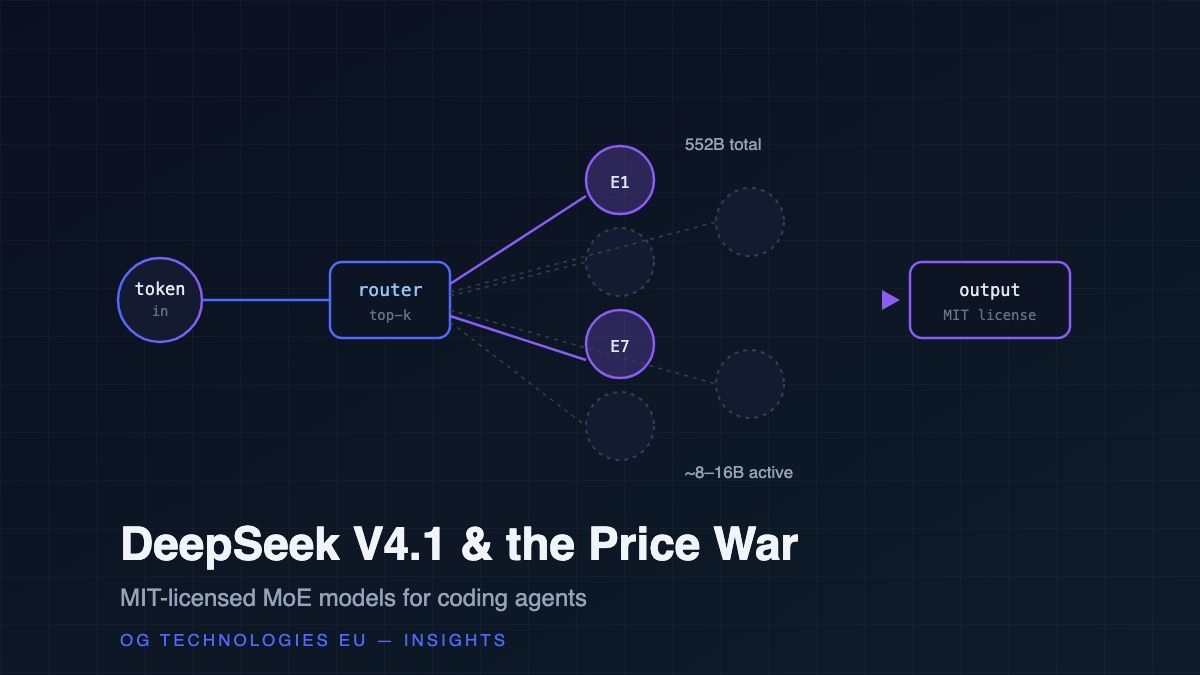
A mixture-of-experts (MoE) model doesn't activate all of its parameters on every token. V4.1's "Causal-Encoder-Decoder" design routes each token through a small subset of specialized subnetworks — around 8B parameters active for input processing and 16B for generation — out of the 552B total. The result is a model with the capacity of a very large network but the inference cost of a much smaller one.
This is the mechanism behind the price war: capability scales with total parameters (the "knowledge" stored), while serving cost scales with active parameters (the compute actually used per token). MoE breaks the old linear trade-off between the two.
Benchmarks: Vendor vs. Independent
The vendor-reported numbers are striking — 90.6 on Terminal-Bench 2.1, a 3471 Codeforces rating — but the honest reading requires the independent measurements: Vals AI scored V4.1 Flash at 74.53% on Terminal-Bench 2.1, second among open-weight models and statistically tied with Kimi K3. On cost-adjusted measures it runs away from the field: roughly 40× cheaper per task than K3 on agentic coding evaluations and about 5× faster.
The takeaway isn't that DeepSeek's claims are wrong — it's that the model's decisive advantage is the cost-quality ratio, not raw capability leadership. For agent loops that retry, explore dead ends, and fan out subtasks, cost per task is the metric that decides whether a workflow is economically viable at all.
Why Cost Per Task Changes the Agent Design Space
Agentic workloads are token-hungry by nature: a coding agent reads files, writes attempts, runs tests, reads failures, and retries — easily 10–50× the tokens of a single-shot answer. At frontier API prices, teams ration agent usage to "important" tasks. At DeepSeek prices:
- Brute-force becomes viable — run N parallel solution attempts and keep the best, a strategy that's simply unaffordable at premium tiers.
- Long-horizon loops get practical — multi-hour migration or refactoring sessions stop being a budget conversation.
- Always-on agents pencil out — continuous dependency monitoring, nightly test-repair runs, standing documentation agents.
MIT License: What It Actually Means
"Open-weight" is not "open source," and licenses differ — some carry revenue caps or usage restrictions. MIT is the permissive end: download the weights, run them anywhere, fine-tune, distill, embed in commercial products, no obligations. For enterprises, that eliminates an entire class of vendor-negotiation and compliance questions that custom licenses create.
The Caveats
- 552B is still big. Self-hosting needs serious GPU infrastructure (multi-node for full precision; quantization helps). Most teams will use hosted APIs or inference providers rather than run their own.
- Data residency and jurisdiction. For EU organizations, sending code or data to a China-based API endpoint raises GDPR and sovereignty questions. Prefer EU/US-hosted inference of the open weights — or self-host — when data sensitivity matters.
- Capability is tier-dependent. V4.1 Flash wins on cost-adjusted agent work; for the hardest reasoning tasks, frontier proprietary models still hold an edge. Route by workload, as with any tiered strategy.
- Vendor-reported benchmarks. Treat claimed leads as provisional until independent evaluators confirm — good practice for every provider, not just this one.
Where It Fits in Your Stack
The emerging pattern: frontier models for judgment-critical steps, open-weight MoE for the volume work — the same tiered routing discipline described in our GPT-6 tier guide. DeepSeek V4.1 Flash is currently the strongest answer to "what runs the inner loops." Whichever models you adopt, track them in your AI inventory — the ISO 42001 AI Readiness Assessment covers the governance side.
Frequently Asked Questions
Is DeepSeek V4.1 really free to use commercially?
Yes — the weights are MIT-licensed, the most permissive mainstream license. You can run, modify, and embed it commercially with no usage restrictions. Hosted API access is priced separately by whichever provider serves it.
Should we self-host or use an API?
Self-host only if you have the GPU capacity (552B total parameters) and the utilization to justify it — continuous high-volume agent fleets, or hard data-residency requirements. Otherwise a hosted open-weights inference provider gives you the same model at per-token prices, often on EU/US infrastructure.
How does it compare to frontier models like GPT-6 or Claude 5.5?
On independent agentic-coding evals it sits just below the proprietary frontier while costing a small fraction per task. The right architecture usually isn't "either/or" — route hard judgment steps to frontier tiers and the high-volume agent loops to open-weight models.
Is it safe to send our code to a DeepSeek-hosted API?
For EU organizations, a China-hosted endpoint raises data-residency and GDPR considerations. The MIT license solves this cleanly: the same weights run on EU/US-hosted inference providers or your own infrastructure, so you can get the model without the data leaving your chosen jurisdiction.