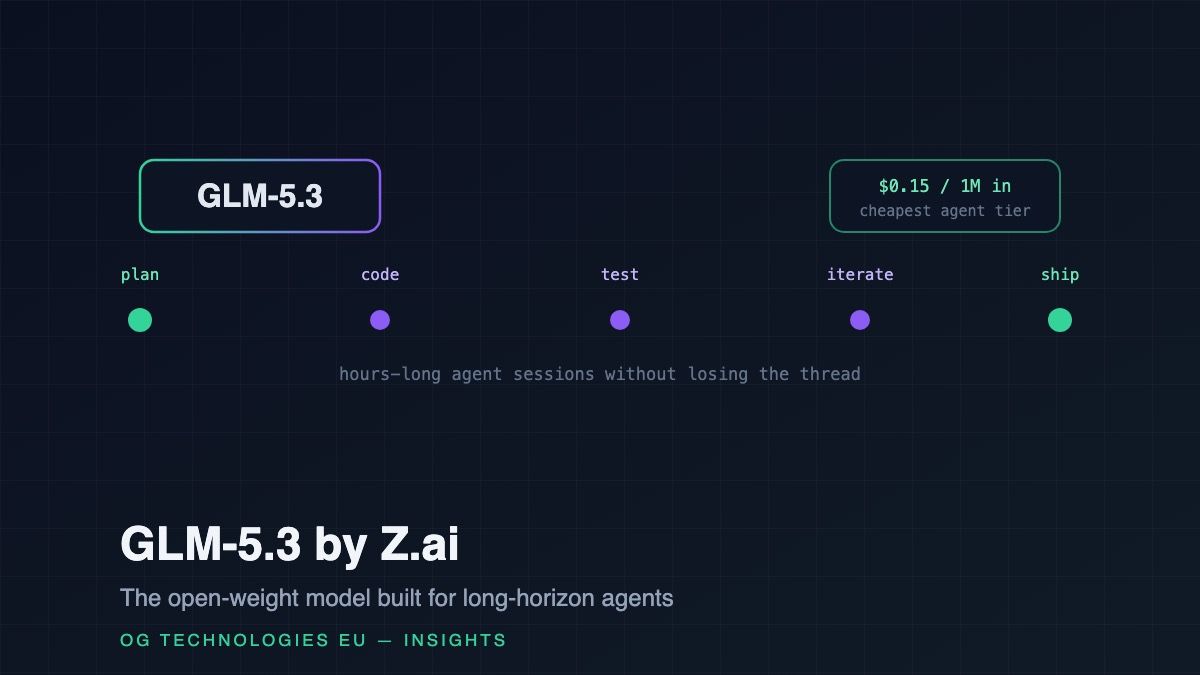
Z.ai — the international brand of Zhipu AI, one of China's foundational model labs — released GLM-5.3 and GLM-5.3-Flash in late August 2026, with open weights following days later. The GLM series has carved out a specific niche in the crowded open-weight field: it is tuned for long-horizon agent and engineering sessions — multi-hour runs where the model must hold context, stay in protocol, and keep making progress — and it prices at the bottom of its capability class.
Where DeepSeek wins on cost-per-task economics and Kimi leads on raw scale, GLM's pitch is endurance: a model you can leave running on a hard problem for hours at an API price that doesn't turn the session into a budget review.
What "Long-Horizon" Actually Means
Most model benchmarks test single-shot or short-horizon performance. Real agent work is different: a migration agent might run hundreds of tool calls over hours, accumulating a long transcript where early decisions constrain later ones. The failure modes are specific — losing track of the plan, drifting out of tool-call format, repeating earlier mistakes — and they only appear at long horizons.
GLM-5.3's tuning targets exactly this: stability across long sessions. In independent comparisons it is consistently positioned for "long-horizon agent and engineering sessions" — the model that stays coherent and on-task where cheaper models start to wander. For overnight migration runs, standing maintenance agents, or deep refactoring loops, that's the property that matters.
GLM-5.3 vs. GLM-5.3-Flash
- GLM-5.3 — the full model for the hardest sessions; open weights released alongside for teams with the infrastructure to self-host.
- GLM-5.3-Flash — the fast variant, scoring near the top of the Flash class on independent indexes and supporting video input (useful for agents that need to interpret screen recordings or UI walkthroughs). Priced at roughly $0.15/$0.50 per million tokens — among the cheapest API options in its class.
Positioning: GLM vs. DeepSeek vs. Kimi
- GLM-5.3: the long-horizon specialist — pick it when sessions run for hours and stability matters more than peak benchmark scores. Flash tier is the cheapest credible option for agent loops.
- DeepSeek V4.1 Flash: the cost-per-task champion — MIT license, ~40× cheaper per agent task than Kimi K3; the default for high-volume, retriable work.
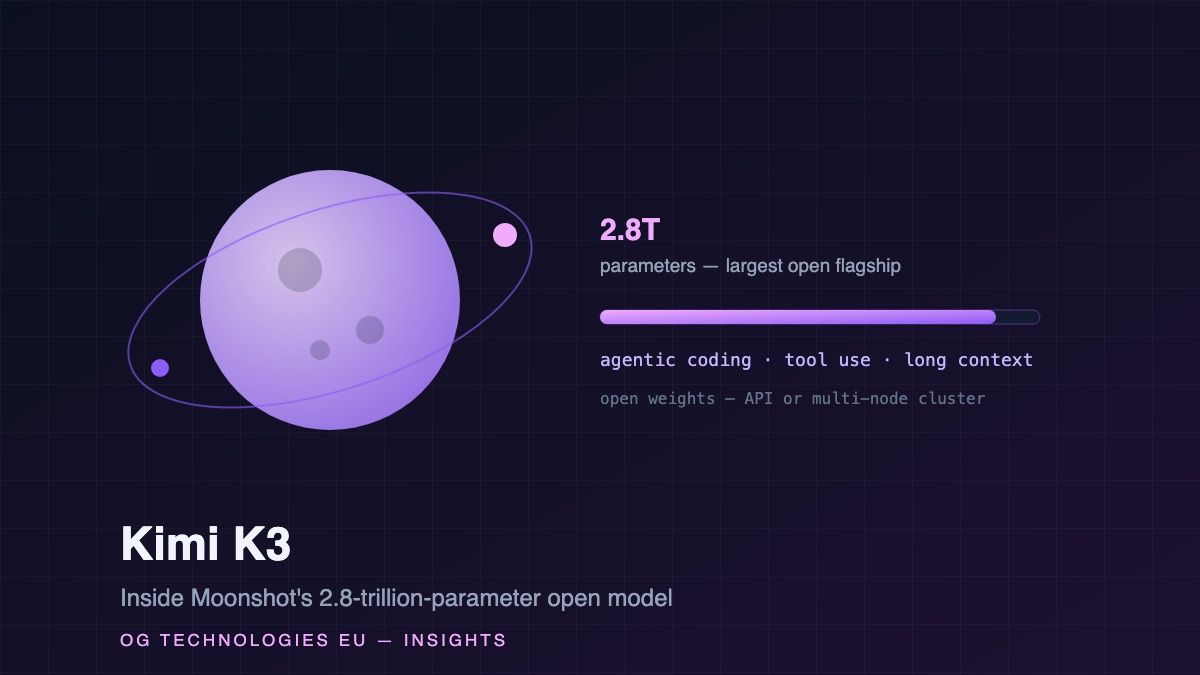
- Kimi K3: the capability ceiling — 2.8T parameters for the hardest agentic problems, API-only for practical purposes.
The honest answer for most teams is a portfolio: GLM or DeepSeek for the volume loops, Kimi or a proprietary frontier model for the hard tail. Our DeepSeek V4.1 and Kimi K3 analyses cover the other two corners; the GPT-6 tier guide applies the same routing logic to the proprietary side.
Practical Adoption Notes
- Open weights: released for self-hosting — feasible for the Flash-class variants, heavier infrastructure for the full model.
- API economics: at $0.15/$0.50 per million tokens, GLM-5.3-Flash makes always-on agent fleets affordable — the difference between "agents for important tasks" and "agents by default."
- Data residency: as with other China-lab models, EU organizations handling sensitive code should prefer providers hosting the open weights in-region rather than the vendor endpoint.
- Evaluate on horizon, not single-shot: when benchmarking GLM against alternatives, use long multi-step tasks — that's where its differentiation actually shows up.
Whichever mix you land on, log the models in your AI inventory with the evals that justified each — the ISO 42001 AI Readiness Assessment gives you the governance baseline in about ten minutes.
Frequently Asked Questions
Is Z.ai the same company as Zhipu?
Yes — Z.ai is the international brand of Zhipu AI, the Beijing lab behind the GLM (General Language Model) series, one of China's earliest foundation-model efforts.
When should we pick GLM over DeepSeek?
When your workloads are long-horizon: multi-hour agent sessions, deep refactoring loops, standing maintenance agents. GLM's differentiation is session stability; DeepSeek's is raw cost-per-task on shorter, retriable work.
What does GLM-5.3-Flash's video input enable?
Agents that can interpret screen recordings and UI walkthroughs — useful for QA agents watching app flows, documentation generation from demos, or verifying UI changes visually instead of only through the DOM.
Are the weights really open?
Yes — GLM-5.3 weights were released openly days after the API launch, enabling self-hosting, fine-tuning, and deployment through third-party inference providers in whatever jurisdiction you choose.