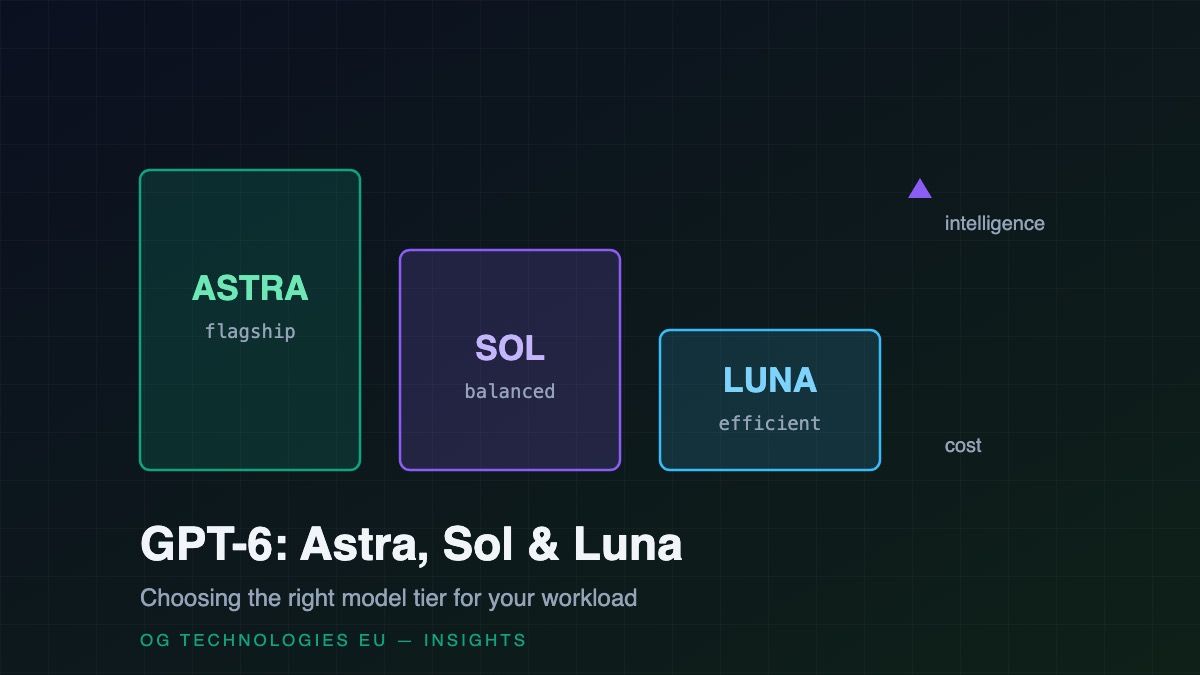
OpenAI's GPT-6 generation arrived in September–October 2026 not as a single model but as a tiered family: GPT-6 Astra at the frontier, GPT-6.1 Sol in the balanced middle, and GPT-6 Luna at the efficient end. The naming is new, but the strategy is familiar from cloud computing — the same capability curve, priced at three points, so that the model you pay for matches the difficulty of the task.
For teams building on the API, the tier choice is now a first-order cost decision: the gap between Astra and Luna pricing is two orders of magnitude per token. Getting routing wrong in either direction — frontier spend on trivial tasks, or cheap models on work that needs depth — is expensive in money or in quality. This guide maps the tiers to workloads.
The Three Tiers
- GPT-6 Astra — the flagship, aimed at complex reasoning, coding, computer use, and long-horizon professional work. Priced around $10/$50 per million input/output tokens. OpenAI positions it as state-of-the-art on frontier benchmarks; use it when task failure costs more than the tokens do.
- GPT-6.1 Sol — the balanced tier, delivering near-Astra performance on most complex work at roughly one-fifth the price ($2/$10 per million tokens). This is the default for production features that need real reasoning but run at volume.
- GPT-6 Luna — the efficient tier at roughly $0.10/$0.50 per million tokens, built for focused, high-volume tasks: classification, extraction, summarization, routing, simple Q&A.
All tiers share a ~1M-token context window, 128K max output, multimodal input, tool use, and adjustable reasoning effort (from none/low through max) — so the lever you pull per-request is effort, while the lever you pull per-workload is the model tier itself.
Mapping Workloads to Tiers
A practical mapping that holds up across most production systems:
- Astra: architecture-level refactors, security analysis, multi-step research agents, legal/financial reasoning, anything where a wrong answer is expensive. Also the right choice when lower tiers demonstrably fail your evals.
- Sol: feature-level code generation, document analysis, customer-facing assistants that need judgment, agent orchestration steps that plan or synthesize.
- Luna: intent classification, entity extraction, PII detection, embedding-adjacent tasks, format conversion, high-volume batch jobs, and the fan-out steps inside larger agent pipelines.
The key insight: reasoning effort and model tier compose. A Luna call at max effort still underperforms Sol on hard reasoning, while an Astra call at low effort is often just an expensive Sol. Tune the two axes independently — tier for ceiling, effort for latency/cost within that ceiling.
Routing Patterns That Work
Most production systems shouldn't hard-code one model. Three patterns dominate:
- Classifier-first routing: a Luna call decides task difficulty, then dispatches to Sol or Astra. Cheap, adds one round-trip, works well when task types are cleanly separable.
- Cascade with verification: run Luna first; if confidence is low or a verification step fails, escalate to Sol, then Astra. Best economics when most traffic is genuinely easy.
- Static per-endpoint assignment: route by feature, not by request — the summarization endpoint always uses Luna, the audit endpoint always uses Astra. Simplest to reason about and to budget.
Whichever you choose, measure it: log the tier used per request, tag spend by feature, and re-run your evaluation suite when a new point release lands — the "right" answer shifts as tiers improve.
Beyond Chat: Intelligent UI and the Agent Surface
GPT-6 also introduced Intelligent UI — responses composed from text and interactive elements rather than a single text blob — and the family is served through the Responses API with function calling, web search, file search, and computer-use tools. For product teams this means the model tier decision now extends to the interface layer: richer UI generation costs more, and the same routing discipline applies.
Governance: Tiering Is a Procurement Decision Too
Model selection belongs in your AI inventory. Under an AI management system you should record which workloads run on which tier, the evaluation that justified it, and who approved frontier spend — the same accountability chain you'd apply to any material vendor decision. If you're formalizing that process, our ISO/IEC 42001 guide covers the framework, and the ISO 42001 AI Readiness Assessment produces a documented baseline you can attach to vendor reviews.
Frequently Asked Questions
Should we always default to the flagship?
No — that's the expensive failure mode. Most production traffic is routine work that Luna or Sol handles at a fraction of the price. Reserve Astra for workloads where you can demonstrate, with evals, that lower tiers fall short.
How stable are the tiers for production?
Model IDs are versioned and point releases ship frequently. Pin model versions per endpoint, run your eval suite before upgrading, and keep a documented rollback — tier improvements can change behavior on edge cases even when averages improve.
Is the ~1M context window a reason to skip retrieval (RAG)?
Usually not. Long context is excellent for single large documents or a codebase slice, but retrieval still wins on cost and latency for corpus-scale questions, and it keeps source attribution explicit.
How do we keep tier spend under control?
Route by workload, cap reasoning effort per endpoint, tag API spend by feature, and review the top-cost endpoints monthly. A monthly report of "tokens by tier by feature" catches drift before it becomes a budget conversation.