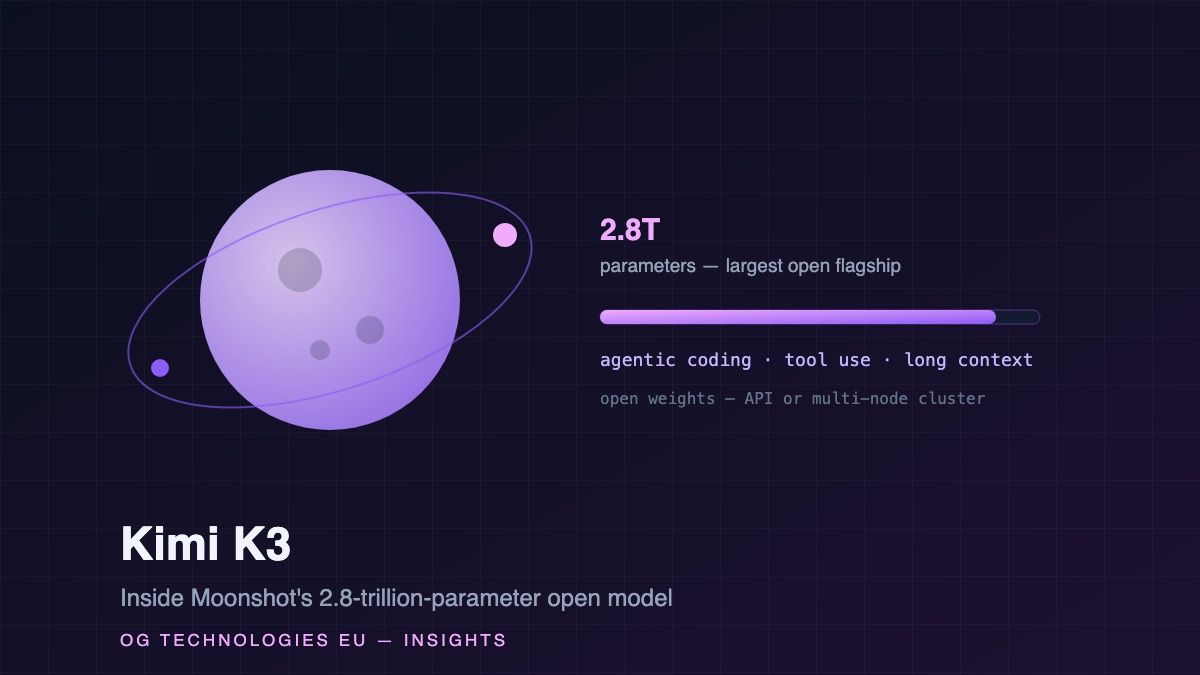
Kimi K3, from Moonshot AI, is currently the largest open-weight flagship model in the world: a 2.8-trillion-parameter mixture-of-experts architecture that sits at or near the top of independent agentic-coding evaluations — statistically tied with DeepSeek V4.1 Flash on the Vals AI index, with the higher ceiling on the hardest agentic tasks.
Kimi's trajectory matters beyond one model. The K2 generation (mid-2025) established Moonshot as the first Chinese lab whose open weights were genuinely competitive for agentic tool use; K3 extends that lead in scale and benchmark depth. For teams evaluating open models in 2026, Kimi is now the reference point for "how good can open weights get?"
What 2.8 Trillion Parameters Buys
In an MoE architecture, total parameter count is capacity — the knowledge and pattern coverage the model can draw on — while active parameters per token determine serving cost. K3's enormous total gives it unusually deep coverage of long-tail code patterns, APIs, and multi-step reasoning traces, which is exactly what agentic tasks stress: the model rarely encounters a situation that is wholly outside its experience.
- Agentic coding strength: K3's benchmark lead concentrates in the hardest categories — multi-file refactors, tool-use chains, and tasks requiring many sequential decisions without losing the thread.
- Long context: the Kimi line built its reputation on long-document reasoning, and K3 continues that — useful for whole-codebase or full-spec tasks.
- Tool use as a first-class behavior: Moonshot trained explicitly for agent loops rather than bolting function-calling onto a chat model — the difference shows in how reliably K3 stays in protocol across long sessions.
The Family: K3 and K2.6
K3 is the flagship; the broader family matters for deployments too. Kimi K2.6 has become a default voice model on inference platforms — optimized for low time-to-first-token, the property that decides whether a real-time voice agent feels responsive. The pattern repeats across the family: a frontier flagship for depth, smaller variants tuned for latency-sensitive surfaces.
The Hosting Reality
Here is the honest constraint: 2.8T parameters is not a self-hostable model for most organizations. Even with MoE sparsity, serving K3 at full quality requires a multi-node GPU cluster — the kind of infrastructure only large platforms and specialized inference providers operate. For nearly every team, the practical route is:
- Hosted API — Moonshot's own endpoint or third-party inference providers that host the open weights.
- Distilled/smaller variants — if self-hosting is mandatory, smaller family members (or distilled checkpoints) trade capability for infrastructure you can actually run.
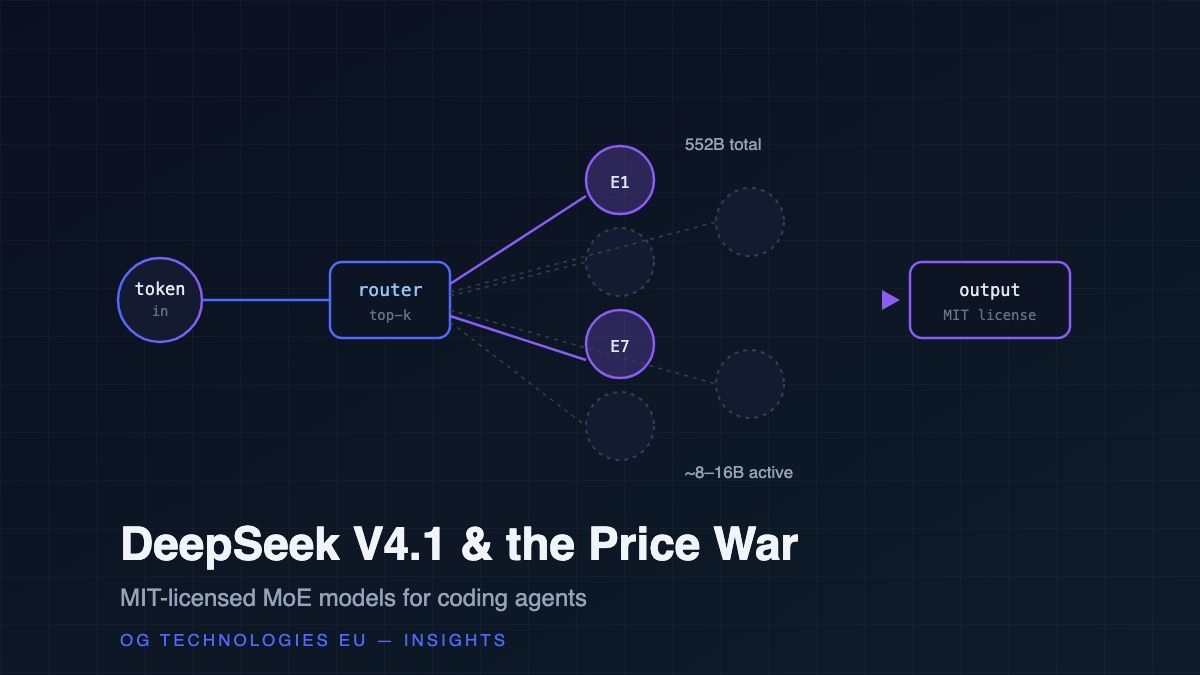
This is the trade-off at the top of the open-weight field: DeepSeek V4.1 Flash (552B) is dramatically cheaper per task and more feasible to self-host; K3 holds the capability edge. The choice is a cost-versus-ceiling decision, not a quality ranking. See our DeepSeek V4.1 analysis for the other side of that comparison.
Context: China's Open-Weight Race
K3 doesn't exist in isolation. The open-weight field has consolidated around four Chinese labs — DeepSeek, Qwen (Alibaba), GLM (Z.ai), and Kimi (Moonshot) — each pushing a different point on the cost-capability curve, all releasing weights that Western labs keep proprietary. For buyers, that competition is a gift: frontier-adjacent capability at commodity prices, with real choice on licensing and hosting.
When to Choose Kimi
- Hardest agentic tasks at open-weight prices — when DeepSeek or GLM retries fail and a proprietary frontier call is too expensive to run at volume.
- Long-document or whole-codebase reasoning — the Kimi lineage's core strength.
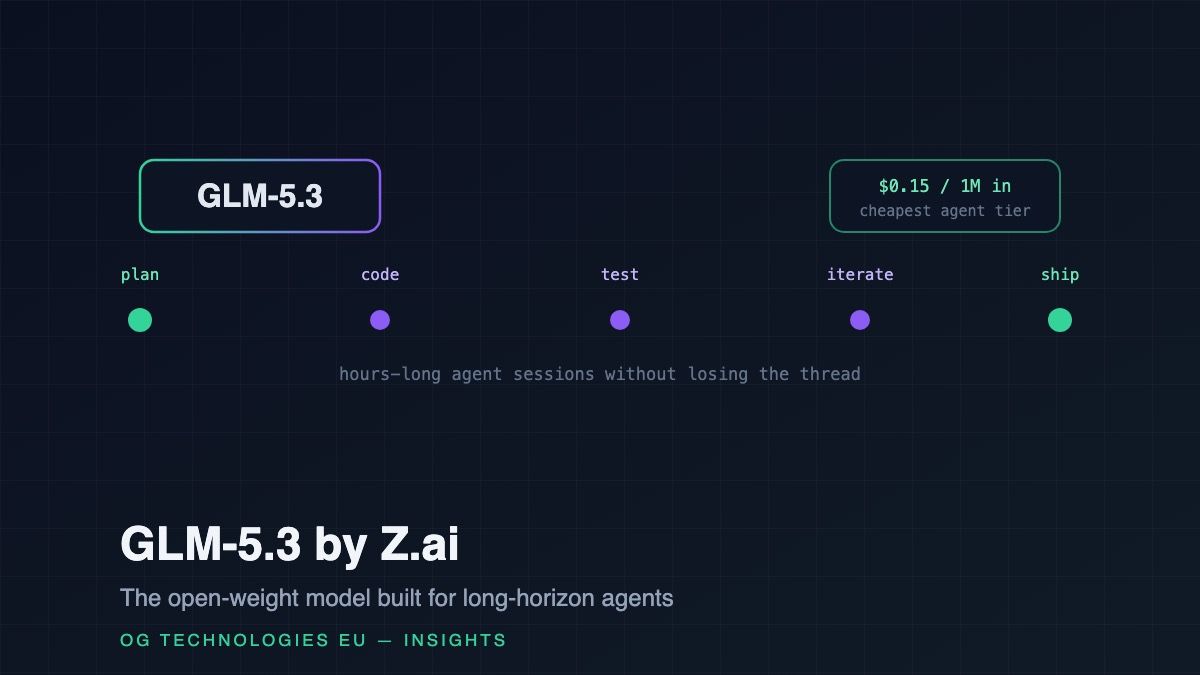
- Evaluation-driven deployments — run your task suite against K3, DeepSeek V4.1, and GLM-5.3; the right answer is workload-specific.
As with any model adoption, record it in your AI inventory with the evaluation that justified the choice — the ISO/IEC 42001 framework gives you the structure, and our AI Readiness Assessment the starting baseline.
Frequently Asked Questions
Can we self-host Kimi K3?
Practically, no — at 2.8T total parameters, full-quality serving needs a multi-node GPU cluster. Use a hosted API, or pick a smaller family variant or distilled model if self-hosting is a hard requirement.
Is K3 better than DeepSeek V4.1?
On independent evals they're statistically tied at the top of the open-weight field, with different strengths: K3 has the higher ceiling on the hardest agentic tasks; DeepSeek is dramatically cheaper per task and more self-hostable. Evaluate both on your own workload.
What about data residency?
Same consideration as any China-lab model: prefer inference providers hosting the open weights in your chosen jurisdiction over the vendor's own endpoint when data sensitivity demands it.
Where does Kimi fit vs. GPT-6 or Claude 5.5?
K3 narrows the gap on agentic benchmarks at a fraction of frontier prices, but proprietary flagships still lead the hardest reasoning work. Most production stacks end up tiered: open-weight models for volume, frontier models for judgment-critical steps.