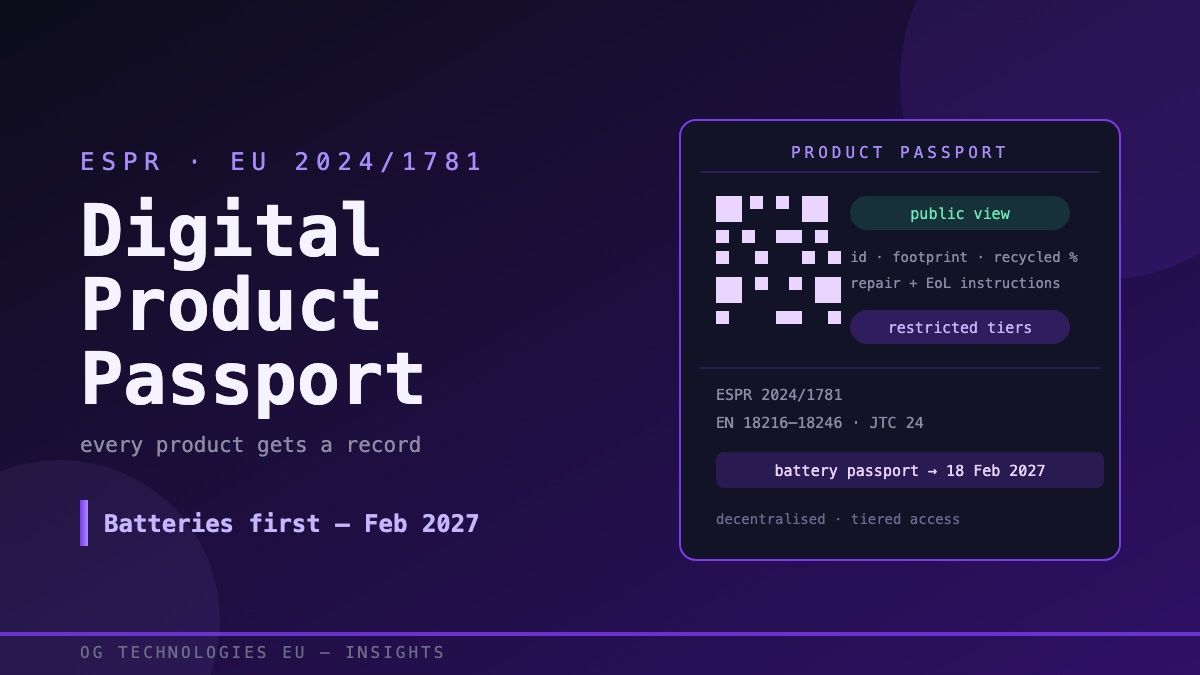
The Digital Product Passport (DPP) stopped being a concept in 2026. The EU's DPP registry went live in July, six of the eight European DPP standards were cited in the Official Journal — giving presumption of conformity — and the first hard deadline is now less than three months away: every EV, e-bike, and industrial battery above 2 kWh placed on the EU market needs a battery passport from 18 February 2027. This guide covers what a DPP actually is, which products follow, and how the technical stack fits together.
What a DPP Actually Is
A DPP is not a document or a label — it is a data system bound to a physical product. A data carrier on the product or packaging — typically a QR code, Data Matrix, NFC tag, or RFID chip — encodes a unique product identifier that resolves to a structured digital record containing:
- Identity — product, batch, or item-level identifiers (ISO/IEC 15459-compatible), manufacturer and importer details.
- Compliance — declarations of conformity, test reports, and the certifications the product carries.
- Sustainability attributes — recycled content, carbon and environmental footprint, durability, repairability scores, expected lifetime.
- Substances of concern — declarable chemicals affecting use, repair, and recycling.
- Circularity data — disassembly instructions, spare-parts information, end-of-life handling for recyclers and remanufacturers.
Two design choices matter. First, access is tiered: consumers see a public subset, while fuller datasets are restricted to supply-chain actors, market-surveillance authorities, and customs — commercial confidentiality is built into the model, not bolted on. Second, storage is decentralized: the data stays with the responsible economic operator (or a DPP service provider it mandates), the data carrier resolves to it, and the central registry handles identifier lookup and customs checks — Brussels does not host your product data.
The Legal Engine: ESPR + Battery Regulation
Two regulations drive the rollout, and confusing them is the most common planning mistake:
- ESPR — Regulation (EU) 2024/1781 — the framework law, in force since July 2024. It establishes the DPP mechanism but sets no product deadlines itself; those arrive through delegated acts, product group by product group. The first working plan (2025–2030) prioritizes iron and steel (act expected around 2026), textiles and apparel (~2027), tyres (~2027), furniture (~2028), mattresses (~2029), and aluminium later in the window — plus horizontal measures on repairability and recycled content, and energy-related products carried over from the old Ecodesign Directive.
- Batteries Regulation — Regulation (EU) 2023/1542, Article 77 — the first binding DPP: from 18 February 2027, every EV battery, light-means-of-transport battery (e-bikes, e-scooters), and industrial battery above 2 kWh needs a battery passport accessed via QR code. Commission guidance published in 2026 lists ~71 data points — identification, chemistry, carbon footprint, recycled content, performance and durability, and repurposing information — split into mandatory, conditional, and public versus restricted fields. The obligation sits with the economic operator placing the finished battery on the market.
Once a delegated act applies to your product group, a conforming DPP becomes a condition of placing the product on the EU market — non-compliant goods can be stopped at customs or withdrawn by market surveillance. That applies to non-EU manufacturers exactly as it does to EU ones; the importer carries verification duties.
The Technical Stack: the EN 18xxx Standards
The horizontal plumbing was built by CEN-CENELEC JTC 24, the joint committee created under standardisation request M/604. Its eight modular standards define how a DPP works — the delegated acts still define what data each product carries:
- EN 18219 — unique identifiers for products, operators, and facilities.
- EN 18220 — data carriers and the physical-to-digital link.
- EN 18216 — data exchange protocols and formats.
- EN 18223 — system interoperability (technical, semantic, organisational).
- EN 18221 — data storage, archiving, and persistence.
- EN 18222 — APIs for passport lifecycle management and searchability.
- EN 18239 — access-rights management, system security, and business confidentiality.
- EN 18246 — data authentication, reliability, and integrity.
The first six were cited in the Official Journal in July 2026 (Implementing Decision (EU) 2026/1736), so a passport built to them is presumed to conform with the ESPR's DPP system requirements; the two security standards followed through the ratification process in autumn 2026. At international level, ISO/IEC JTC 5 — initiated on the back of JTC 24's work — now coordinates global DPP standardisation, which matters if your products also ship outside the EU.
Note what the stack does not mandate: a specific backend technology. Identifiers, carriers, protocols, and APIs are specified — whether your data layer uses conventional databases, a blockchain, or verifiable credentials is an implementation choice. On-chain anchoring can help where multiple supply-chain parties must write to one record without trusting one operator — the same pattern we cover in blockchain sustainability reporting — but it is optional, not required.
Who Does What
- Manufacturers — create the passport, populate the data points the delegated act requires, keep it maintained through the product lifecycle, and back it up (or mandate a DPP service provider to).
- Importers and distributors — verify the passport exists and is valid before placing the product on the market; the manufacturer stays responsible for content.
- Dealers and online marketplaces — must not sell products lacking a required passport and must make the data carrier accessible to customers.
- Authorities — market surveillance and customs get privileged access; the registry gives customs an automated conformity check at the border.
A Pragmatic Sequence for Manufacturers
- Map exposure: place your product lines against the working-plan sequence — steel and textiles first, and batteries under their own deadline regardless.
- Inventory the data: the gap is rarely the data carrier — it is assembling recycled-content, footprint, and substances data that lives with suppliers. Start the supply-chain data requests early.
- Pick the identifier and carrier scheme: GS1/GTIN-based or ISO/IEC 15459 identifiers, and QR/Data Matrix for most consumer products — align with what your packaging and logistics already print. Our GTIN glossary entry covers the identifier basics.
- Decide build vs service provider: self-hosting is viable for narrow catalogs; multi-supplier, multi-market products usually justify a DPP service provider conforming to EN 18222.
- Pilot on the nearest deadline: a battery-passport or textile pilot exercises every muscle — data collection, tiered access, carrier printing — before the general obligation lands.
If you already run product compliance work — Cyber Resilience Act documentation, SBOMs, sustainability reporting — the DPP is the layer that publishes the product-facing slice of that same evidence. Build the data pipeline once; serve several regimes.
Frequently Asked Questions
Is the Digital Product Passport mandatory now?
Not horizontally — the obligation activates per product group when its delegated act takes effect. The one binding deadline already fixed is the battery passport: 18 February 2027 for EV, LMT, and industrial batteries above 2 kWh. ESPR delegated acts for iron and steel, textiles, tyres, and furniture follow through the rest of the decade.
Does the DPP require blockchain?
No — the regulation and the EN 18xxx standards are technology-neutral. They specify identifiers, data carriers, protocols, APIs, and access rights; the backend can be a conventional database, a distributed ledger, or verifiable credentials. Decentralized tech helps for multi-party supply-chain writes but is an implementation choice.
Who can see the data in a DPP?
Access is tiered by design. Consumers get a public subset — identity, key sustainability attributes, use and end-of-life instructions. Supply-chain actors see what they need for their role, market-surveillance authorities and customs get privileged access, and commercially confidential fields are protected under EN 18239's access-rights model.
Does the DPP apply to non-EU manufacturers?
Yes — the requirement attaches to the product placed on the EU market, not to where the manufacturer is based. A non-EU manufacturer must still supply a conforming passport; the EU importer shares verification duties, and customs can stop products whose passport is missing or invalid.
How is a DPP different from CE marking?
CE marking is the visible signal that a product meets its applicable EU requirements; the DPP is the data carrier that exposes the underlying product information — compliance documents, sustainability attributes, lifecycle data — in machine-readable form. Where both apply, the passport complements the mark rather than replacing it.