When an ESG auditor, a funder's due-diligence team, or a procurement department asks a blockchain project to substantiate its sustainability claims, one response does not survive scrutiny: citing a document still in draft. Published, stable, citable standards are the only currency assurance providers accept — and here is the uncomfortable truth most "blockchain for good" decks skip: no single published standard covers the sustainability reporting of a distributed-ledger deployment end to end. What exists instead is a mature, layered stack: DLT terminology and governance documents from ISO/TC 307, greenhouse-gas and energy measurement standards, disclosure frameworks like GRI and ESRS, and market-integrity rules for carbon claims. This article assembles that stack — and maps each layer to where the evidence actually lives on Stellar.
The Three-Layer Map
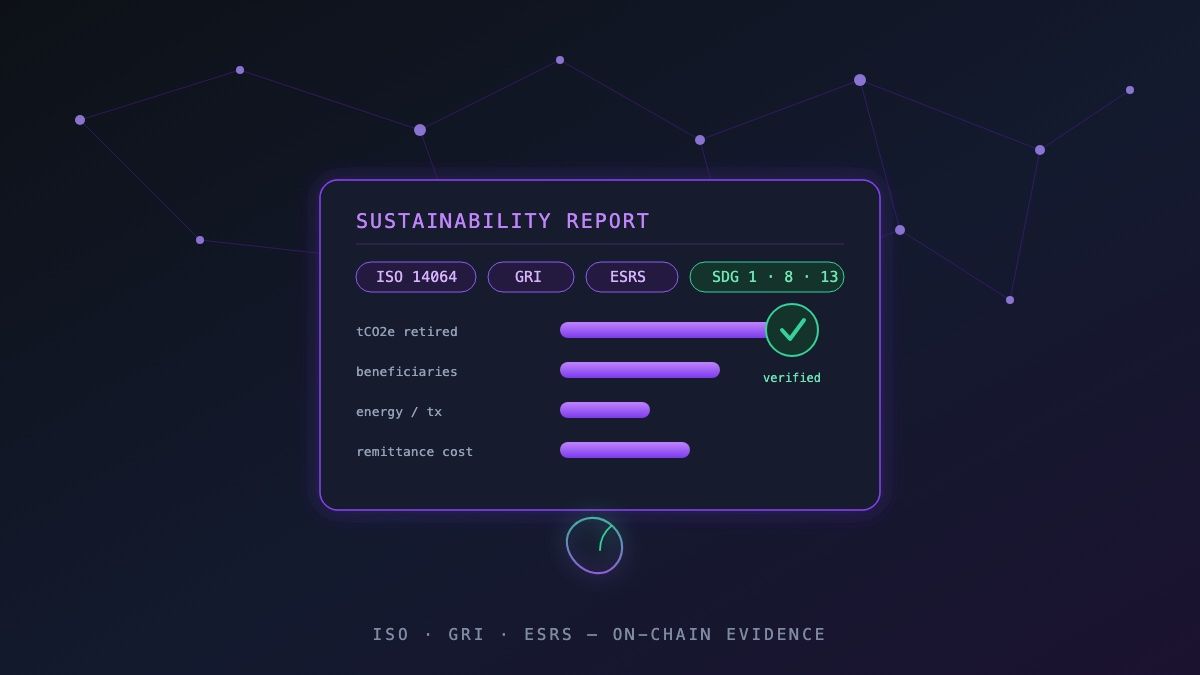
Think of the reporting problem as three questions, each answered by a different body of published material: what are we describing (terminology, architecture, governance — the ISO/TC 307 corpus), what are we measuring (energy, emissions, and outcomes — ISO 14064, the GHG Protocol, the UN indicator framework), and what are we disclosing (format and materiality — GRI, ESRS/CSRD, IFRS S2). A defensible report names a published reference at every layer. Below, each layer gets its own section, plus the carbon-market rules that govern the most common on-chain sustainability claim of all: the offset.
Layer 1 — The DLT Corpus: What ISO/TC 307 Has Published
ISO's blockchain committee has produced a corpus of published International Standards, Technical Specifications, and Technical Reports. None of them is a sustainability standard — their job in your reporting stack is subtler: they give your claims the shared vocabulary and governance structure that make a document auditable rather than anecdotal.
| Document | What it is | What it contributes to your report |
|---|---|---|
| ISO 22739:2024 | Vocabulary (full International Standard, edition 2) | Normative definitions — finality, oracle, DLT node, smart contract. Cite it so "finality" in your KPI section means the same thing to your auditor as it does to you |
| ISO/TR 23455:2019 | Overview of and interactions between smart contracts | The state-of-the-art reference on smart-contract lifecycle and interactions — the citable basis for describing what your contracts do and how they bind |
| ISO/TS 23635:2022 | Guidelines for governance | A published governance checklist — upgrade authority, key management, dispute handling — that maps directly onto the "governance and reporting practices" disclosures in GRI 2 |
| ISO 23257:2022 | Reference architecture | A shared model for describing system boundaries — essential when an assurance provider asks where your measurement boundary sits |
| ISO/TR 3242:2022 | Use cases | The canonical taxonomy of what DLT is deployed for — positions your application class against a published catalogue rather than marketing categories |
| ISO/TR 23244:2020 | Privacy and PII protection considerations | The citable basis for how beneficiary data is kept off-ledger — a question every social-impact claim eventually raises |
Two discipline notes. First, mind the document class: an IS (like 22739) is normative; a TS is a specification approaching standard status; a TR (like 23455 or 3242) is informative guidance — cite it as a reference, never as a requirement you "comply" with. Second, editions matter: ISO 22739:2024 is the current second edition (a further revision is already in progress), so pin the year in every citation. A sustainability report that says "per ISO 22739" without the edition will be flagged by a competent reviewer.
Layer 2 — Measuring the Footprint: GHG Protocol, ISO 14064 and the UN Indicators
The measurement layer is where blockchain teams most often improvise — and where published standards are most unforgiving. For energy and emissions, the two canonical frameworks are the GHG Protocol (Corporate Standard plus Scope 2 and Scope 3 standards — open and free) and the ISO 14064 series: 14064-1 for organisation-level quantification, 14064-2 for project-level reductions and removals, and 14064-3 for verification. ISO 14065 then accredits the bodies doing that verification — the full chain from measurement to assurance. ISO 14067 covers product carbon footprints, ISO 50001 structures energy management, and ISO 14068-1:2023 governs what you may call "carbon neutral."
For a DLT deployment the boundary question dominates: consensus energy (negligible on federated-BFT networks like Stellar's SCP, dominant on proof-of-work), node operation (scope 2 — purchased electricity), infrastructure and oracle dependencies (scope 3 — the hardest, mostly estimated), and embedded device footprints. Documenting which consumption sources are inside your boundary, which grid intensity factors you applied, and how much of the data is measured versus estimated is not optional polish — ISO 14064-1 makes that disclosure the substance of the report.
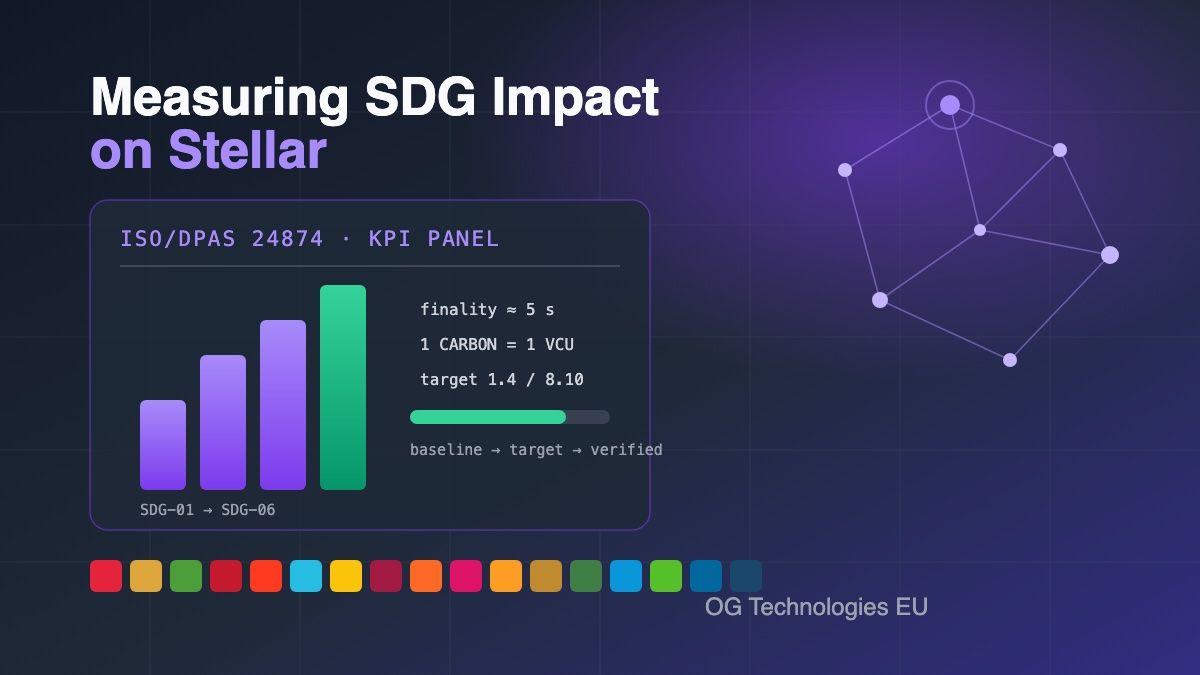
Outcome claims have their own canonical source: the UN Global Indicator Framework maintained by the IAEG-SDGs. It is the authoritative catalogue behind every SDG target — the same indicators statisticians use for national reporting. Map your metrics to official indicator wording: financial-inclusion deployments land on targets 1.4 and 8.10, remittance corridors on 10.c, climate projects on 13.2. Quoting the framework's own language is the difference between an impact claim and an SDG-shaped advertisement.
Layer 3 — Disclosure: GRI, ESRS and IFRS S2
Measurement answers "how much"; disclosure answers "in what format, covering what, for whom." Three published frameworks dominate, and they divide by materiality lens rather than by quality:
- GRI Standards — the impact-materiality workhorse. The Universal Standards (GRI 1–3) frame every report; the topic standards do the heavy lifting for DLT: GRI 302 (Energy), GRI 305 (Emissions), GRI 203 (Indirect Economic Impacts — where financial-inclusion and aid-delivery outcomes belong), and GRI 413 (Local Communities).
- ESRS under CSRD — mandatory double materiality for in-scope EU companies: financial and impact. ESRS E1 carries climate metrics, ESRS S3 affected communities, ESRS 2 the general disclosures — including governance that ISO/TS 23635's checklist maps onto neatly. Assurance starts at limited and escalates; on-chain records help, but auditors test the controls around the data, not the ledger itself.
- IFRS S1/S2 (ISSB) — financial materiality for investor audiences, increasingly adopted across jurisdictions. Climate disclosures align with TCFD architecture; on-chain evidence slots in as documentation quality, not as a new disclosure category.
None of these frameworks cares which database produced your numbers. What they evaluate is boundary discipline, methodology, data-quality tiers, and assurance readiness. That is good news: it means a well-instrumented ledger is an evidence advantage, not a compliance category of its own.
The Carbon-Market Integrity Layer
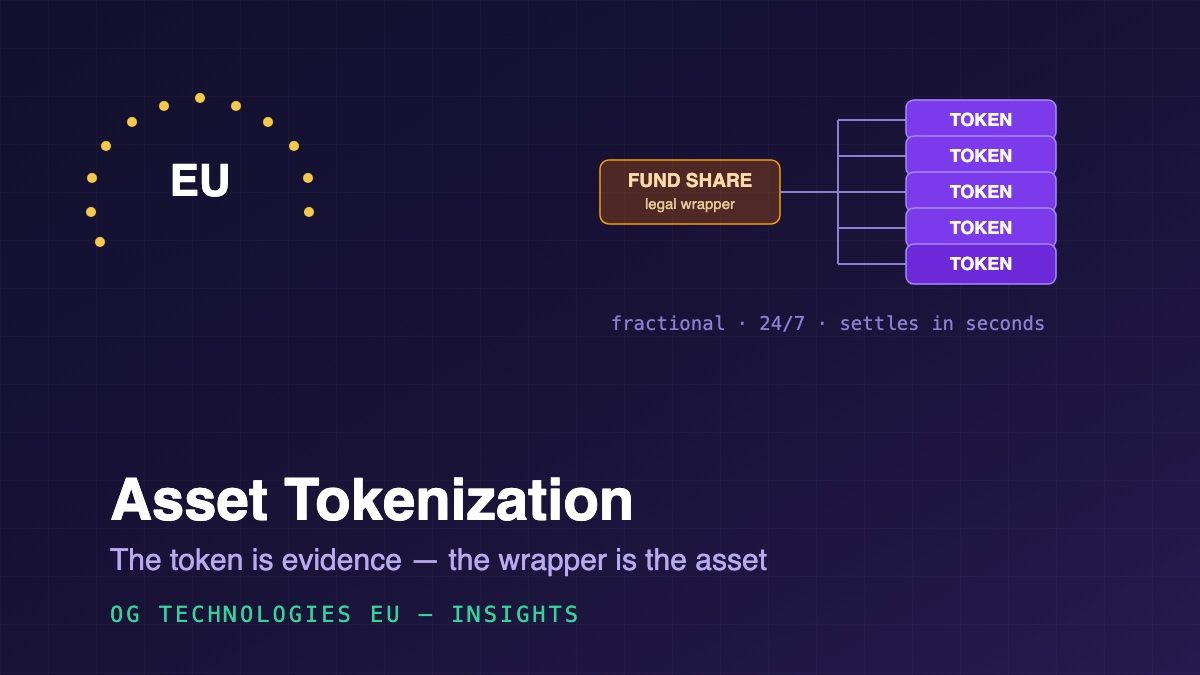
Tokenized carbon credits are where sustainability reporting on-chain goes wrong most visibly, because three distinct published rulebooks apply — and a token satisfies none of them by itself. Verra's Verified Carbon Standard governs issuance and retirement of VCUs: the registry retirement is the environmental claim. The ICVCM Core Carbon Principles define which credits are high-integrity enough to use at all. And the VCMI Claims Code of Practice governs what you may publicly assert — the difference between "we retired VCUs" and "our product is carbon neutral" is a claim-tier question, not a token question. On Stellar, StellarCarbon's CARBON asset illustrates the defensible pattern: each token mirrors a VCU retired in the Verra Registry, so the ledger becomes a public audit trail pointing at a registry claim — never a substitute for it.
Worked Example: A Stellar Deployment Mapped Line by Line
Take two canonical Stellar sustainability patterns — a humanitarian disbursement rail and a carbon-sinking integration — and force every report line through a published reference:
| Report line | Governing published reference | Evidence source |
|---|---|---|
| Terms: "smart contract," "finality," "oracle" | ISO 22739:2024 | Glossary section citing the edition |
| Contract governance: upgrades, key custody, disputes | ISO/TS 23635:2022; GRI 2-9/2-12 | Governance log, contract upgrade history, multisig policy |
| Energy use of nodes and infrastructure | ISO 50001; GRI 302-1 | Node metering, hosting provider data; documented boundary |
| GHG emissions (operations + upstream) | GHG Protocol scopes 2/3; ISO 14064-1 | Electricity × grid intensity; estimation methodology note |
| "Carbon neutral" or offset claims | ISO 14068-1; VCMI Claims Code; ICVCM CCP | Verra retirement records mirrored on-chain (CARBON) |
| Beneficiaries reached / financial inclusion | UN indicator framework 1.4, 8.10; GRI 203 | Programme M&E + Horizon disbursement records (PII kept off-ledger per ISO/TR 23244) |
| Cost per verified outcome | GRI 203 methodology; programme reporting | On-chain fees + operating cost ÷ verified outcomes |
| Remittance cost reduction | UN indicator 10.c | Corridor pricing vs the 5% SDG benchmark |
| EU disclosure format (in-scope entities) | ESRS E1 / S3 / ESRS 2 under CSRD | All of the above, assurance-ready |
Notice what the table does not contain: a blockchain standard for impact measurement. It does not exist yet in published form — which is precisely why every row borrows its authority from the measurement, disclosure, and integrity layers around the ledger rather than from the ledger itself. The chain supplies evidence; the standards supply legitimacy. For the KPI-side methodology of measuring SDG outcomes on Stellar specifically, see our guide to measuring SDG impact on Stellar.
Honest Caveats
- The corpus is young. ISO/TC 307's published output is still mostly vocabulary, architectures, and technical reports — several are already under revision. Pin editions and expect numbers and titles to change at the next cycle.
- A TR is not a requirement. Quoting ISO/TR 23455 or ISO/TR 3242 as though they imposed obligations is a category error auditors notice. They are references; treat them as such.
- Scope 3 is estimation territory. Oracle infrastructure, anchor operations, and end-user devices mostly produce modelled numbers. Disclose the estimation share; a precise-looking number without a methodology note is worse than an honest range.
- The token is not the claim. An on-chain record of a carbon credit, a donation, or a delivery is evidence pointing at a real-world event. The claim lives or dies on the off-chain side: registry status, MRV quality, attribution.
- Attribution stays hard. Neither GRI nor ESRS resolves the counterfactual — whether beneficiaries would have been reached anyway. Keep "contributing to" language wherever causality cannot be isolated.
Where This Leaves Builders
The practical stack, in one sentence: describe your system in ISO/TC 307 vocabulary, measure footprint and outcomes with ISO 14064, GHG Protocol, and UN indicators, disclose in GRI or ESRS format, and route carbon claims through Verra, ICVCM, and VCMI. Assembled properly, a Stellar deployment's native telemetry — fees, finality, immutable transaction records — stops being a novelty and becomes what an assurance provider actually wants: a tamper-evident evidence base under a recognised reporting frame.
We engineer this layer in production: Mozart Pay pairs Stellar payment rails with ISO 20022 reporting, and the Stellar Go CLI couples DID-attested payments with registry-backed carbon offsets. If your sustainability report needs to survive an audit rather than a slide deck, talk to us.
Frequently Asked Questions
Is there a published ISO standard for blockchain sustainability reporting?
Not as a single document. The published stack is assembled: ISO/TC 307 documents (ISO 22739 vocabulary, ISO/TR 23455 smart contracts overview, ISO/TS 23635 governance) supply DLT terminology and governance structure; ISO 14064, the GHG Protocol, and ISO 50001 supply emissions and energy measurement; and GRI, ESRS, or IFRS S2 supply the disclosure format. No published standard yet benchmarks smart contracts against sustainability KPIs end to end.
Which GRI disclosures apply to a blockchain deployment?
GRI 302 (Energy) and GRI 305 (Emissions) cover the footprint; GRI 203 (Indirect Economic Impacts) covers financial-inclusion and aid-delivery outcomes; the GRI 2 general disclosures cover governance and reporting practices — where ISO/TS 23635's governance checklist maps neatly. On-chain data feeds the metrics, but GRI still requires organisational boundaries, methodology notes, and management context around them.
Does CSRD/ESRS apply to blockchain companies?
Scope turns on company size and listing status, not technology. In-scope companies report under ESRS regardless of the substrate their systems run on — on-chain records serve as evidence for ESRS E1 climate metrics or S3 community disclosures, but the framework evaluates double materiality, data quality, and assurance readiness, not which ledger produced the numbers.
Do tokenized carbon credits count in sustainability reports?
Only when the underlying credit is retired in a recognised registry. A token mirroring a retired Verra VCU — such as StellarCarbon's CARBON asset on Stellar — is defensible evidence; the token itself is not the claim. ICVCM Core Carbon Principles govern whether the credit quality is high-integrity, and the VCMI Claims Code governs what you may publicly assert about the retirement.
Which SDG indicators map to a payment-focused deployment?
The UN Global Indicator Framework supplies the canonical references: target 1.4 (equal rights to economic resources and financial services), 8.10 (capacity of domestic financial institutions to expand access), and 10.c (remittance transaction costs below 5%). Map each on-chain metric to official indicator wording and document the attribution level — "contributing to" wherever causality cannot be isolated.