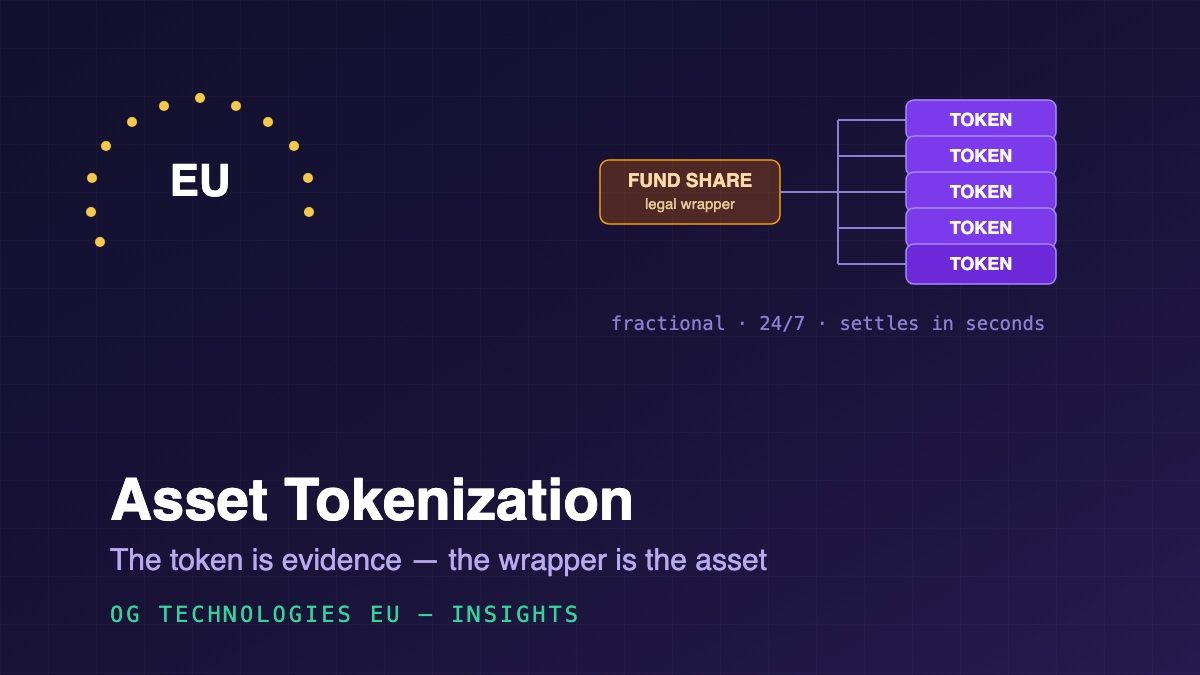
Tokenization means issuing a claim on a real-world asset — a fund share, a bond, a money-market position, a bar of gold — as a transferable record on a distributed ledger. That is the whole trick, and also the part most explainers skip: the token is evidence of the entitlement, not the asset itself. What moved the concept from conference slides to balance sheets in 2026 is that the legal wrappers finally caught up: MiCA is fully applicable in the EU, the SEC gave DTCC a no-action letter for tokenizing custodied securities, and tokenized real-world assets passed ~$36 billion across all chains — with roughly $4 billion on Stellar alone as of September 2026.
The Legal Wrapper Comes First
Every credible tokenized product is two things at once: a conventional legal instrument (a registered fund share, a security held by a custodian, a deposit claim on a bank) and an on-chain record that mirrors who is entitled to it. The ledger can become the official system of record — Franklin Templeton's BENJI fund uses Stellar exactly that way — but only because a regulator accepted that the blockchain register is the shareholder register. Skip the wrapper and you have a token that represents nothing enforceable. This is why "tokenize my building" projects fail: the hard part was never the mint button.
The Three EU Regulatory Boxes
In the EU, "is this legal?" resolves into a classification question — which regime does the token fall under:
- MiCA crypto-assets. Fully applicable since December 2024, MiCA covers crypto-assets not already regulated as financial instruments: asset-referenced tokens (baskets/commodity-backed), e-money tokens (single-currency stablecoins), and other crypto-assets. Issuers need white papers, reserves, redemption rights, and — for significant tokens — direct EBA supervision. CASPs servicing them need authorization.
- Tokenized securities (MiFID II + DLT Pilot Regime). A tokenized share, bond, or fund unit is a security — MiCA explicitly steps aside and MiFID II rules apply unchanged. The DLT Pilot Regime (Regulation 2022/858, applying since March 2023) then grants targeted exemptions so market infrastructures can run trading and settlement on DLT: shares under EUR 500M market cap, bonds under EUR 1B issuance, and UCITS units — via DLT multilateral trading facilities, settlement systems, or combined TSSs. Uptake has been modest enough that the Commission proposed extending its scope and duration under the market-integration package.
- Tokenized deposits. A bank deposit represented on a ledger stays a deposit — banking law, not MiCA, governs it. Same for wholesale settlement assets and, eventually, a digital euro.
The practical consequence: legal qualification precedes architecture. A "tokenized T-bill fund" is a MiFID security project; a "EUR settlement token" is an e-money-token project; a loyalty point is usually neither. They share a ledger but not a rulebook — our blockchain compliance checker maps which frameworks a given setup triggers.
How Issuance Actually Works
Once the wrapper exists, the on-chain part is a defined pipeline rather than magic:
- Structure the entitlement. Register the instrument (fund share class, note, SPV interest) and designate the ledger's role — mirror of record vs. official register.
- Issue the asset. On Stellar that means creating an asset with control flags — authorization-required, clawback, freeze — so holder rules are enforced by the network itself rather than audited out of custom contract code. Regulated-asset standards like SEP-8 require issuer sign-off on transfers.
- Gate the holders. KYC runs through the distribution rail — on Stellar, the SEP-9/SEP-12 KYC standards wired into SEP-24 deposit/withdrawal anchors — so only verified wallets can hold or receive.
- Distribute and settle. Investors buy fractional units, transfers settle in ~5 seconds with finality, 24/7, and the underlying asset stays with its custodian or CSD — the token moves, the gold doesn't.
What Is Actually Live
This is no longer a pilot program story. On Stellar — where our team builds — the RWA market went from ~$525M at the start of 2026 to roughly $4 billion by September, across ~70 tokenized products from regulated issuers:
- Franklin Templeton BENJI (~$605M) — the first U.S.-registered mutual fund using a public blockchain as system of record.
- Spiko (~$1.55B) — tokenized money-market funds, including a share class managed by Amundi.
- WisdomTree — 15 SEC-registered tokenized funds spanning money market, equity, fixed income, and alternatives, plus a gold token.
- Ondo USDY (~$535M) — tokenized U.S. Treasury exposure.
- Sovereign debt — ~$490M of non-U.S. government paper (Mexican CETES, Brazilian bonds) circulating on-chain.
The biggest tell is DTCC: after a December 2025 SEC no-action letter, the Depository Trust Company is connecting its tokenization service to Stellar — DTC-custodied assets (Russell 1000 constituents, index ETFs, Treasuries) are expected on-chain in the first half of 2027. When the entity that custodies most of the world's securities starts tokenizing them, the debate about whether this is "crypto" is over.
Why Institutions Actually Care
- Settlement compresses. T+2 becomes seconds, delivery-versus-payment becomes atomic — cash leg and asset leg in one transaction, no reconciliation window.
- Fractionalization widens the buyer pool. A EUR 500M bond doesn't divide; its token does.
- Markets stop closing. Transfers and collateral moves run 24/7/365 — the argument that sold treasurers on weekend margin calls.
- Compliance moves into the asset. Transfer restrictions, allowlists, and clawbacks are enforced by the ledger, not reconstructed in spreadsheets after the fact.
The honest counterweights: liquidity is still fragmented across chains and walled-garden platforms; a tokenized fund nobody trades is just an expensive share class; and legal finality still lives in the wrapper, not the wallet. Tokenization removes intermediation cost — it does not remove intermediaries, it relocates them to issuance, custody, and distribution.
If You're Considering It: A Practical Sequence
- Classify the token. Security, e-money token, ART, or none of the above — the answer picks your regulator, not your roadmap.
- Fix the wrapper. Prospectus, fund documentation, or white paper — the entitlement has to exist legally before it exists on-chain.
- Pick the compliance surface. Protocol-enforced controls (issuer approval, freeze, clawback) for regulated assets vs. open smart-contract logic for unregulated ones.
- Choose rails deliberately. Public networks give reach and composability; permissioned ledgers give control and less distribution. Most institutional launches hedge with both.
- Wire distribution and reporting. KYC-gated issuance, cap-table reconciliation, and the audit trail regulators — and your auditor — will ask for first.
We build on Stellar payment and issuance rails and track the standards layer through ISO/TC 307 and CEN-CENELEC — if you're scoping a tokenized product, our blockchain consulting team can qualify the regulatory path and design the issuance architecture, or request a quote. The Stellar and MiCA glossary entries cover the terminology.
Frequently Asked Questions
Is tokenization legal in the EU?
Yes — but the regime depends on what the token represents. Plain crypto-assets and stablecoins sit under MiCA (fully applicable since December 2024). A tokenized share, bond, or fund unit is a security under MiFID II; the DLT Pilot Regime then provides the sandboxed legal path for trading and settling it on DLT infrastructure. Tokenized deposits stay under banking law. There is no "tokenization law" — there is a classification exercise.
Does the token replace the legal ownership record?
Sometimes — when a regulator accepts the ledger as the official register, as Franklin Templeton's BENJI does on Stellar. More often the token mirrors a conventional register maintained by a custodian or CSD, as in DTCC's model where the asset stays in custody and the token carries the entitlement. Either way, enforceability flows from the legal wrapper, not from the token standard.
Is a tokenized security a crypto-asset under MiCA?
No — that is the most common misreading. MiCA deliberately covers only crypto-assets not already regulated as financial instruments. A tokenized security stays a security: prospectus rules, MiFID II conduct requirements, and CSDR settlement law all apply. The DLT Pilot Regime relaxes specific obstacles so those instruments can actually live on a ledger.
Public or permissioned chain for issuance?
Public networks won the institutional argument largely on distribution — investors, custodians, and counterparties already exist there, and compliance can live at the protocol layer (Stellar's issuer-authorization and clawback flags, for example). Permissioned ledgers still make sense for bilateral settlement between known institutions, but nothing about a private chain exempts you from securities law — it mostly limits who can buy.
What is a realistic first use case?
The 2026 data says: yield-bearing instruments. Money-market funds, Treasury exposure, and short-dated sovereign debt dominate live issuance because the economics are legible — daily yield, transparent backing, instant settlement — and the wrapper is a fund structure lawyers already know. Real estate and art get the headlines; cash equivalents get the volume.