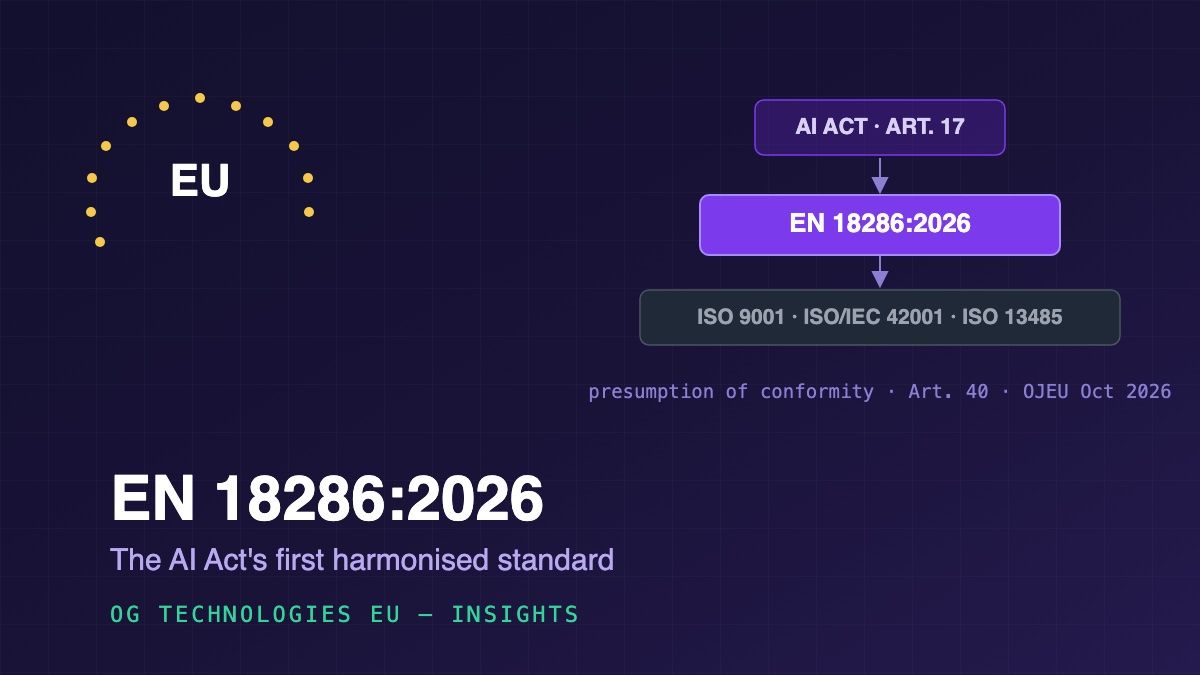
On 14 October 2026 the European Commission published Implementing Decision (EU) 2026/2274, citing EN 18286:2026 — "Artificial intelligence: Quality management system for EU AI Act regulatory purposes" — in the Official Journal. It is the first harmonised standard under Regulation (EU) 2024/1689, developed by CEN-CENELEC JTC 21 and adopted in July 2026. The citation matters more than the publication: since that date, providers of high-risk AI systems that implement the standard enjoy a presumption of conformity with the quality management system requirements of Article 17 — the first time a standard gives anyone a legally recognised shortcut into the AI Act.
What Article 17 Actually Requires
Article 17 obliges every provider of a high-risk AI system to put in place a documented quality management system — and it tells you what must be in it:
- A strategy for regulatory compliance, including conformity-assessment procedures and change management
- Techniques and procedures for design, development, quality control, and quality assurance of the AI system
- Specifications and procedures for examination, testing, and validation before, during, and after development — including what data is needed
- Data management: acquisition, collection, analysis, labelling, storage, filtration, aggregation, and retention for the entire lifecycle
- The risk-management system required by Article 9
- Post-market monitoring (Article 72) and serious-incident reporting (Article 73)
- Record keeping, documentation handling, and retention — including automatically generated logs
- An accountability framework assigning responsibilities to management and staff
In short: not a policy document, but an operating system for how an organization builds, controls, monitors, and takes responsibility for a high-risk AI system — proportionate to its size. Until now, providers had to assemble that from Article 17's legal text alone.
What EN 18286 Is — and How It Is Built
EN 18286 translates those Article 17 obligations into auditable QMS requirements. Three design choices define it:
- Lifecycle-scoped, not organisation-scoped. The standard is built around the AI system's lifecycle — conception through retirement — rather than the organisation as a whole, which is what classic management-system standards do.
- Regulation-scoped. An Annex ZA maps each clause of the standard to the Article 17 requirements it covers, which is exactly what makes the presumption of conformity mechanically defensible in an audit or market-surveillance review.
- Designed to layer. Informative annexes map EN 18286 to EN ISO 9001 and EN ISO/IEC 42001, so an existing QMS or AIMS becomes the base you extend — not a parallel system to run. Providers in regulated sectors (medical devices under ISO 13485, for example) can integrate rather than duplicate.
Presumption of Conformity: What It Buys You
Under Article 40 of the AI Act, applying a harmonised standard cited in the OJEU gives you presumption of conformity — but only for the requirements the standard covers. For EN 18286 that means Article 17's QMS duties: market-surveillance authorities and notified bodies must accept a compliant QMS as evidence for that article unless they can show otherwise. It shifts the burden of proof and removes interpretive guesswork.
It does not cover Articles 8–15 — the technical requirements on risk management, data governance, technical documentation, record keeping, transparency, human oversight, accuracy, robustness, and cybersecurity. You still demonstrate those through the conformity-assessment route (internal control per Annex VI, or a notified body for biometrics). Using the standard remains voluntary: you may satisfy Article 17 any other way — you just carry the full burden of showing how.
EN 18286 vs ISO/IEC 42001 vs ISO 9001
The three standards answer different questions and are best combined, not compared:
- ISO 9001 — generic quality management for any product or service. It gives you document control, nonconformity, internal audit, and management review machinery, but knows nothing about AI systems or the AI Act.
- ISO/IEC 42001 — an organisation-level AI management system: policies, roles, impact assessment, and the 38 Annex A controls (see our controls reference and readiness guide). Excellent governance scaffolding — but certification confers no presumption of conformity under the AI Act.
- EN 18286 — a regulation-scoped QMS keyed to Article 17 and the AI system lifecycle. It is the only QMS standard whose application produces legal effect under the Act.
The pragmatic play: if you already run ISO 9001 or ISO/IEC 42001, use EN 18286's annex mappings to extend what you have — the standard explicitly assumes integration, not a second certificate. If you have neither and place high-risk AI on the EU market, EN 18286 is the shortest defensible route to Article 17. Our integrated management system guide covers how the shared Harmonized Structure makes this layering work in practice.
What Is Still Missing
EN 18286 covers one of the ten areas in the Commission's standardisation request. The rest of the JTC 21 pipeline is still working through the process — three more standards have reached the Enquiry phase:
- prEN 18228 — AI risk management (Article 9)
- prEN 18282 — cybersecurity specifications for AI systems (Article 15)
- prEN 18229-1 — AI trustworthiness framework, Part 1: logging (Article 12)
Until those are cited, presumption of conformity exists only for Article 17. Everything else — data governance, transparency, human oversight, robustness — still needs a self-built conformity argument backed by your technical documentation (Article 11, Annex IV).
Who Needs It — and When
Article 17 binds providers of high-risk AI systems. For Annex III use cases — employment screening, creditworthiness, critical infrastructure, law enforcement, and the rest — the provider obligations including the QMS have applied since 2 August 2026. For AI embedded as a safety component in products under Annex I harmonisation legislation (machinery, medical devices, toys, lifts), the deadline is 2 August 2027. If you are unsure whether you are a provider or a deployer, our AI Act compliance guide walks through the role test — rebranding, substantial modification, or repurposing into high-risk flips you into provider status.
A Practical Sequence
- Confirm provider status and risk class. Map each AI system against Annex III and Article 6 before buying anything.
- Obtain EN 18286 through your national standardisation body — CEN-CENELEC standards are licensed, not free downloads (Austrian Standards in Austria, DIN in Germany, etc.).
- Gap-map your existing system. Use the annex mappings against ISO 9001, ISO/IEC 42001, or ISO 13485 — a readiness assessment is a fast first pass.
- Fill the lifecycle gaps. Data management, post-market monitoring, serious-incident reporting, and the accountability framework are where most existing QMSs fall short.
- Wire it to the technical file. The QMS must produce and maintain the Annex IV technical documentation and feed the conformity assessment — it is not a standalone binder.
- Track the pipeline. Watch for OJEU citations of prEN 18228, 18282, and 18229 — each extends your presumption coverage.
If you want the Article 17 machinery built rather than described, our GRC & management-system automation service implements QMS registers, monitoring workflows, and evidence trails — or request a quote. The EU AI Act glossary entry covers the regulation's terminology.
Frequently Asked Questions
Does following EN 18286 make us AI Act compliant?
Only for Article 17. The presumption of conformity covers the quality management system requirements the standard maps to — not the technical obligations in Articles 8–15 (data governance, transparency, human oversight, accuracy, cybersecurity), which still require their own conformity argument and Annex IV technical documentation.
Is EN 18286 mandatory?
No — harmonised standards are voluntary. But the alternative is demonstrating Article 17 conformity yourself, with the full burden of proof on you. Given that EN 18286 is currently the only standard cited in the OJEU, it is the only route that shifts that burden.
We are ISO/IEC 42001 certified — do we still need EN 18286?
You are not required to adopt it, but ISO/IEC 42001 certification alone produces no presumption of conformity — as we note in our AI Act guide, it is evidence of governance maturity, not a legal safe harbor. EN 18286's annexes let you extend your existing AIMS rather than rebuild it, which is the intended design.
Who does the Article 17 QMS apply to?
Providers of high-risk AI systems — entities that develop an AI system and place it on the market or put it into service under their own name. Deployers, importers, and distributors have different obligations (Articles 26, 23, 24), and providers of GPAI-only models follow the Article 53/55 regime instead.
Where do we get the standard?
Through the national standardisation bodies that make up CEN and CENELEC — Austrian Standards, DIN, AFNOR, and so on. It is a licensed document, not a free download. Annex ZA inside it is the table auditors will check your coverage against.
When does the QMS duty actually bite?
For Annex III high-risk systems it already has — provider obligations applied from 2 August 2026. For AI embedded as a safety component in regulated products under Annex I (medical devices, machinery, toys), the deadline is 2 August 2027. If you are in the first group, this is catch-up, not preparation.