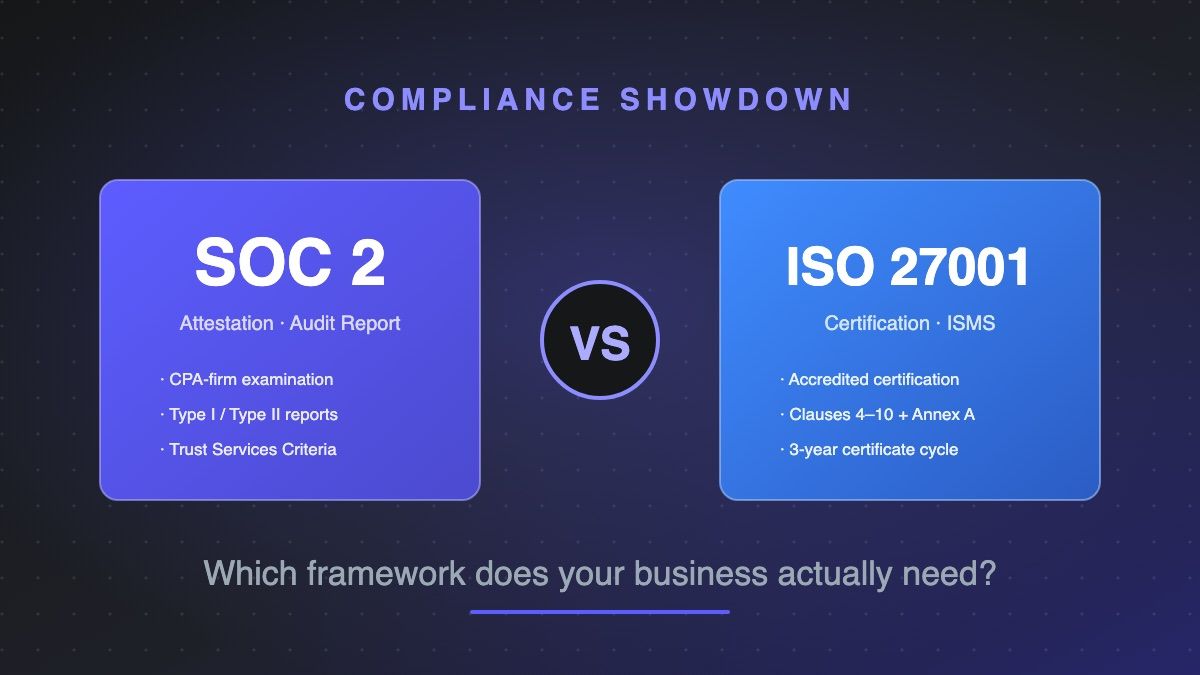
SOC 2 and ISO/IEC 27001 answer the same buyer question — "can we trust you with our data?" — through different machinery. ISO 27001 is a certification: an accredited body audits your Information Security Management System against a published standard and issues a certificate valid for three years. SOC 2 is an attestation: a licensed CPA firm examines your controls against the AICPA's Trust Services Criteria and issues an opinion report — a snapshot (Type I) or a track record over 3–12 months (Type II). One produces a certificate for your wall; the other produces a report you hand to customers under NDA.
Measuring where you stand? Our free tools cover both: the SOC 2 Readiness Checker scores you against the Trust Services Criteria, and the ISO 27001 Gap Analysis assesses your ISMS against clauses 4–10 and Annex A.
The Core Differences at a Glance
| Dimension | SOC 2 | ISO 27001 |
|---|---|---|
| What it is | Attestation — a CPA firm's opinion on your controls | Certification — conformance to an international standard |
| Issued by | Licensed CPA firms (service auditors) | Accredited certification bodies |
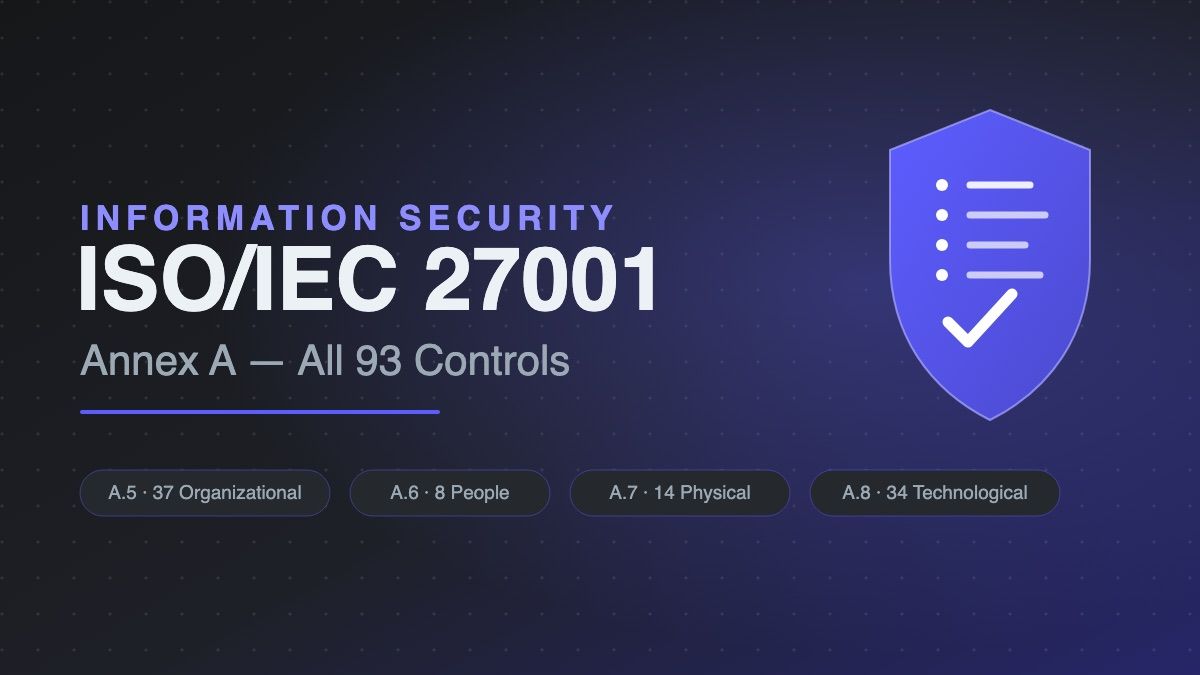
| Evaluated against | Trust Services Criteria — 33 Common Criteria + optional categories | Clauses 4–10 + Annex A's 93 controls |
| Prescriptiveness | Criteria define outcomes; you design the controls | Named control catalogue; SoA documents your selection |
| Validity | Report is a point-in-time or period artifact — buyers expect annual refresh | 3-year certificate with annual surveillance audits |
| Geography | US-centric; the default ask in American enterprise procurement | International; dominant in Europe, Asia, and regulated sectors |
| Deliverable | Detailed auditor's report (often 50+ pages) shared under NDA | Certificate + scope statement — publicly shareable |
Type I vs Type II — and the ISO Equivalent
SOC 2's Type I examines whether controls are suitably designed at a point in time; Type II verifies they operated effectively across an observation period (typically 3–12 months). There's no exact ISO analog — the closest mapping is Stage 1 (design/documentation review) vs Stage 2 (operating effectiveness), except ISO's Stage 2 samples weeks of operation rather than months. The practical consequence: a SOC 2 Type II is a rolling commitment — the evidence window never really closes — while an ISO certificate renews on a 3-year cycle with lighter annual surveillance.
How Much Work Actually Overlaps?
Substantially — the AICPA publishes official mappings between the Trust Services Criteria and ISO/IEC 27001 Annex A. CC1–CC5 (environment, communication, risk, monitoring, control activities) align with ISO's organizational and management-system requirements; CC6–CC8 (access, operations, change management) align with its technological controls. Most practitioners estimate 60–80% control overlap: an organization with a functioning ISMS has already built the risk assessment discipline, access management, change control, incident response, and monitoring machinery SOC 2 tests.
The remaining gap is mostly about evidence shape: SOC 2 auditors want operating-effectiveness evidence across a period (access review sign-offs, incident tickets, change approvals per week/month), while ISO audits sample the same controls but weigh documented conformity more heavily. Companies running both often maintain a single control set with two evidence views.
Which One Do You Need?
Follow your customers. Selling to US enterprises — especially SaaS, fintech, or healthtech deals — expect the SOC 2 question early; procurement teams often won't advance without a Type II report. Selling into Europe, Asia, or regulated industries (automotive, government), ISO 27001 is the recognized credential. Selling globally, large enterprises increasingly hold both: SOC 2 for the US pipeline, ISO 27001 everywhere else.
If starting from zero and choosing one: ISO 27001 first is often the better foundation — it forces you to build the management system (risk assessment, SoA, internal audit, management review) that everything else hangs on, and the Annex A controls give you a concrete implementation list rather than outcome-style criteria. Then layer SOC 2 on top with a relatively small delta. The reverse order works too — SOC 2's criteria map back cleanly — but teams frequently find the SOC 2 report alone harder to run as an ongoing program without ISMS machinery.
Cost and Timeline Reality
Both take months, not weeks, and cost scales with organization size and starting maturity. Typical paths: SOC 2 Type I can land in 3–6 months for a prepared company (readiness work plus the audit itself); Type II adds the 3–12 month observation period. ISO 27001 certification typically runs 6–12 months end-to-end for a mid-size company. Audit fees for either start in the low five figures and rise with scope — the internal implementation effort is usually the larger cost. Running a self-assessment first — SOC 2 or ISO 27001 — is the cheapest way to find out how much runway you actually have.
Managing both long-term? The integrated-management-system approach applies — shared policies, one risk register, one audit calendar. See how ISO standards integrate into one management system, and the ISO 9001 implementation guide for the same pattern applied to quality management.
Frequently Asked Questions
Is SOC 2 a certification?
No — it's an attestation. A CPA firm issues an opinion report on whether your controls meet the Trust Services Criteria; there is no certificate and no pass/fail in the certification sense (auditors issue unqualified, qualified, or adverse opinions). Colloquially "SOC 2 certified" just means "has a clean recent report."
Does SOC 2 satisfy ISO 27001 requirements (or vice versa)?
No — they are separate frameworks with different auditors and deliverables. A SOC 2 report does not confer ISO 27001 certification, and an ISO certificate is not a SOC 2 report. However, 60–80% of the underlying controls overlap, so the second framework is substantially cheaper to add than the first.
Which is harder to get?
Comparable effort for most organizations, distributed differently. ISO 27001 demands more documentation discipline (the ISMS, SoA, mandatory records). SOC 2 Type II demands more operational consistency — controls must demonstrably run every week for months, which catches teams whose processes exist on paper but slip in practice.
Do we need both?
Only if your customers require both. If you sell into US enterprise procurement and international/regulated markets simultaneously, holding both removes recurring deal friction. Otherwise pick the one your target buyers ask for — one clean report beats two half-built programs.
What about SOC 3?
SOC 3 covers the same Trust Services Criteria but produces a short public report — essentially a shareable marketing version of SOC 2 (with a seal you can display). It requires having completed a SOC 2 examination; it's a publishing format, not a separate audit.