
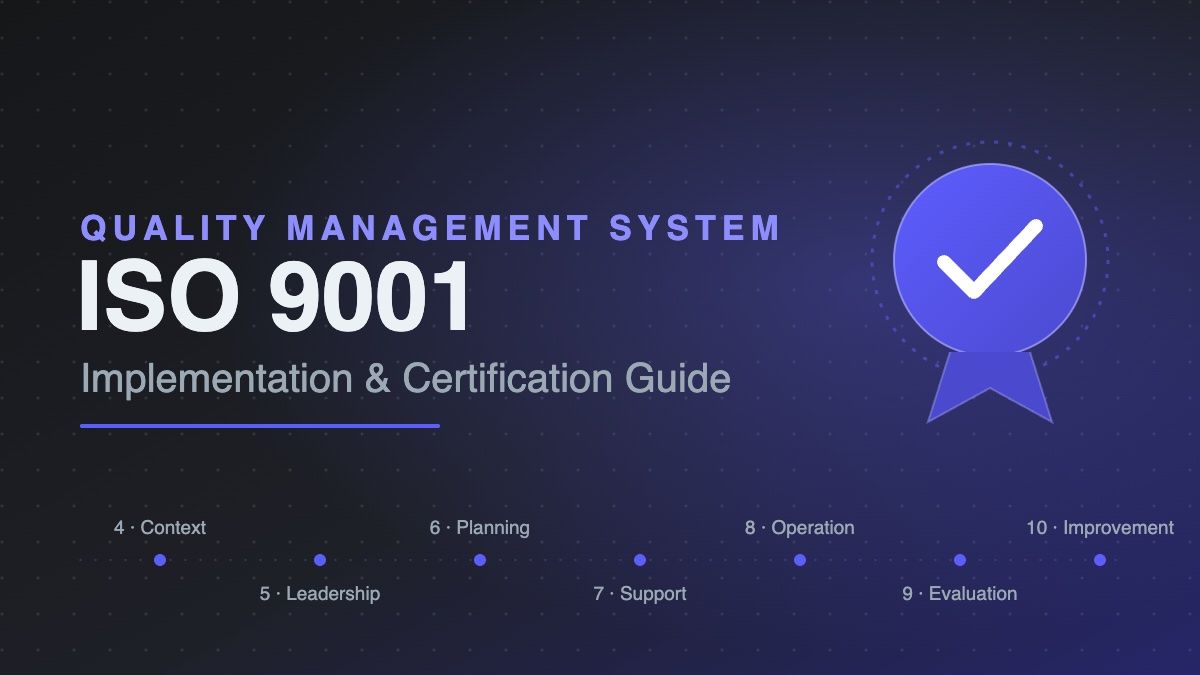
ISO 9001:2015 is the most widely adopted management system standard in the world — over a million organizations hold certification. It defines the requirements for a Quality Management System (QMS): the set of processes an organization uses to consistently deliver products and services that meet customer and regulatory requirements. Unlike ISO 27001 or ISO 42001, there is no control catalog or Statement of Applicability — conformance means satisfying the requirements of clauses 4–10. This guide walks through what the standard actually demands, how to implement it, and what to expect from the certification audit.
What ISO 9001:2015 Actually Requires
Clauses 1–3 are boilerplate (scope, normative references, terms). All auditable requirements live in clauses 4–10, which follow the Plan-Do-Check-Act cycle:
- Clause 4 — Context of the Organization: define the QMS scope, internal/external issues, and the needs of interested parties (customers, regulators, suppliers, owners).
- Clause 5 — Leadership: top management must demonstrably own the QMS — establish the quality policy, assign roles, and drive customer focus. Delegating the entire QMS to a quality manager is a classic audit finding.
- Clause 6 — Planning: address risks and opportunities, and set measurable quality objectives at relevant functions and levels.
- Clause 7 — Support: provide resources, ensure competence and awareness, manage communication, and control documented information.
- Clause 8 — Operation: the discipline-specific core — operational planning, requirements review, design and development, control of external providers, production and service provision, release of outputs, and handling of nonconforming product.
- Clause 9 — Performance Evaluation: monitor and measure the QMS, track customer satisfaction, run internal audits (9.2), and hold management reviews (9.3).
- Clause 10 — Improvement: a working nonconformity and corrective action process (10.2), plus evidence of continual improvement.
Underpinning the clauses are the seven quality management principles from ISO 9000 — customer focus, leadership, engagement of people, process approach, improvement, evidence-based decision making, and relationship management. Auditors don't certify the principles directly, but they are the lens through which conformance is judged, and weak answers about them are how Stage 1 audits start going wrong.
The Implementation Roadmap
- Secure leadership commitment and define the scope. Without genuine top-management accountability the project stalls — clause 5 exists precisely because auditors look for this first. Be explicit about which products, services, sites, and processes the QMS covers.
- Run a gap assessment. Map current practices against clauses 4–10. Most organizations already satisfy far more of the standard than they expect — the gap analysis tells you whether you're building a QMS or documenting one. Our free ISO 9001 Readiness Checker produces a scored baseline in about ten minutes.
- Map your core processes. The process approach is the heart of ISO 9001: identify each process, its inputs and outputs, its owner, and how it interacts with the others. A one-page process map is worth more than a hundred pages of procedures nobody reads.
- Establish the quality policy and objectives. The policy commits you to meeting requirements and improving continually; the objectives must be measurable, assigned to functions, and reviewed — "improve quality" is not an objective, "reduce escaped defects 20% by Q4" is.
- Build only the documented information you need. The 2015 revision dropped the mandatory quality manual and prescribed procedures. You still must maintain documented information (scope, policy, objectives) and retain records as evidence — competence, monitoring results, internal audits, management reviews, nonconformities. Write documents people actually use.
- Implement and operate. Roll out the processes, train staff to competence (clause 7.2), and bring outsourced processes and suppliers under control (clause 8.4).
- Verify before you certify. Complete at least one full internal audit (9.2) and one management review (9.3) covering all QMS elements — a certification body will check that both happened.
- Book the certification audits. Stage 1, then Stage 2 — described below.
How the Certification Audit Works
Certification is a two-stage audit by an accredited certification body:
- Stage 1 — documentation and readiness review. The auditor reviews your scope, documented information, process map, internal audit and management review records, and confirms you're ready for Stage 2. Gaps found here are reported as areas of concern — fix them before proceeding.
- Stage 2 — implementation effectiveness. The auditor samples processes on site, interviews staff, and checks records to verify the QMS actually works — not just that documents exist. Major nonconformities must be resolved before the certificate issues; minors get a corrective-action deadline.
- The 3-year cycle. The certificate is valid for three years with annual surveillance audits (typically sampling a subset of clauses each year) and a full recertification audit before expiry.
Choose a certification body accredited by an IAF-MLA signatory national body (UKAS, DAkkS, ANAB, etc.) — accreditation is what makes the certificate internationally recognized rather than decorative.
Baseline your QMS in ten minutes
Our free ISO 9001 Readiness Checker walks you through clauses 4–10 and the quality management principles in a structured questionnaire, scores your readiness on a 0–100 scale with a letter grade, and generates a PDF report with a prioritized gap list and remediation advice — ready to share with management or your auditor.
Browser-based self-assessment — not a substitute for the standard or a formal audit.
DIY, Consultant, or Hybrid?
A small organization with simple processes and a motivated owner can implement ISO 9001 in-house — the standard is deliberately generic, and templates plus a good gap assessment carry you a long way. Bring in a consultant when the scope spans multiple sites, when a customer deadline is tight, when your industry layers additional requirements on top (automotive IATF 16949, aerospace AS9100, medical ISO 13485 all extend the ISO 9001 skeleton), or when nobody internally has survived a certification audit before. The most common model is hybrid: a consultant for the gap analysis and audit preparation, internal staff for documentation and day-to-day implementation — which also builds the in-house competence the QMS needs after the consultants leave.
Three failure modes account for most stalled projects: over-documentation (writing binders for the auditor instead of processes for the business), single-owner syndrome (the QMS lives in one person's head and dies when they leave), and audit theater (optimizing for the certificate rather than for fewer defects and happier customers — auditors can tell).
ISO 9001 in the Bigger Standards Picture
ISO 9001 shares the Harmonized Structure — identical clauses 4–10 — with ISO 27001, ISO 42001, ISO 14001, and ISO 45001. If any of those are on your roadmap, design the QMS to integrate from the start: one document control system, one internal audit program, one management review. Our integrated management system guide explains how to run quality, security, and AI governance on shared machinery — and why ISO 9001 is usually the right chassis to build on. The gap-assessment methodology is identical across standards too; our ISO 27001 gap analysis guide covers scoring and remediation planning in depth.
Frequently Asked Questions
How long does ISO 9001 implementation take?
For a small organization with reasonably documented processes, typically 3–6 months. Mid-size companies should budget 6–12 months, and multi-site or regulated-scope implementations 12–18 months. The dominant variable is how much process documentation already exists — the gap assessment tells you where you are on that curve.
Is ISO 9001 certification mandatory?
No — it is a voluntary standard. In practice it is often contractually mandatory: many tenders, supply chains, and enterprise customers require it, and sector schemes like IATF 16949 (automotive) and AS9100 (aerospace) build directly on it.
What is the difference between implementing ISO 9001 and getting certified?
Implementation means building and running the QMS; certification means an accredited third party has audited it and issued a certificate. You can implement without certifying — many organizations do, for internal discipline — but only certification produces the document customers and procurement portals ask for.
What are the seven quality management principles?
Customer focus, leadership, engagement of people, process approach, improvement, evidence-based decision making, and relationship management. They come from ISO 9000:2015 and form the conceptual basis for the clause requirements — auditors don't score them directly, but they frame how conformance is judged.
How much does ISO 9001 certification cost?
Certification-body fees scale with headcount and sites via audit-day tables (IAF MD5). Small companies typically pay €3,000–€10,000 for the initial audit cycle, plus annual surveillance fees — internal effort or consultant fees for implementation are separate and usually the larger cost.
Does ISO 9001 have a control catalog like ISO 27001's Annex A?
No. ISO 9001 is purely clause-based — conformance means satisfying clauses 4–10. There is no Annex A control list and no Statement of Applicability; that mechanism belongs to ISO 27001 and ISO 42001.