
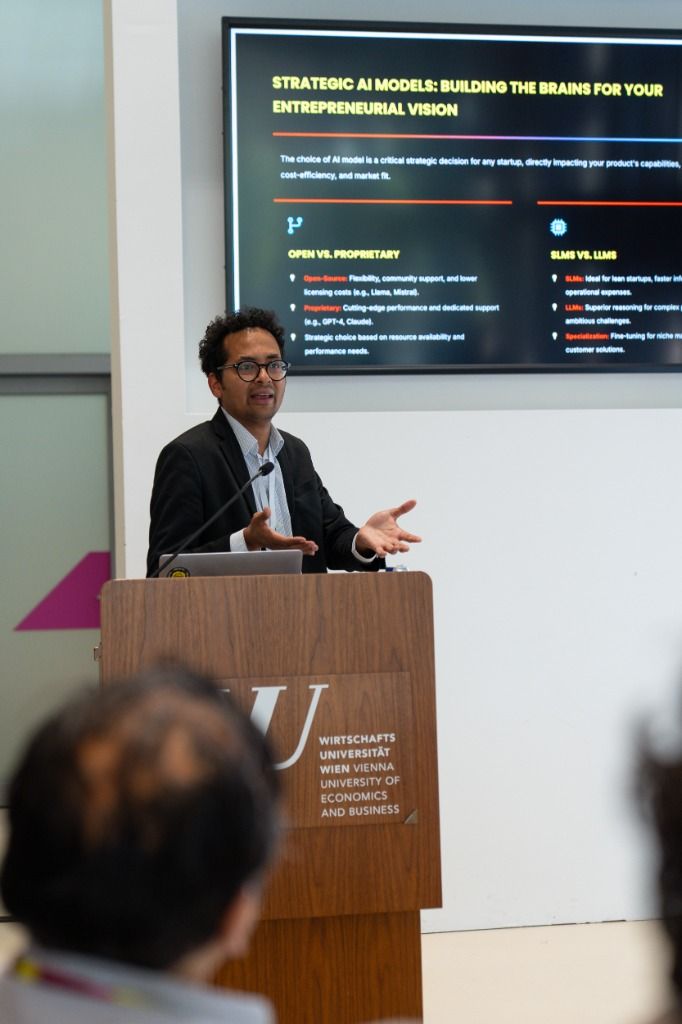
Earlier this year, I had the pleasure of running a workshop titled "AI Agent Architecture: Fueling Entrepreneurial Innovation" at Entrepreneurship Avenue 2026, hosted at WU Wien (Vienna University of Economics and Business). The conference brings together students, founders, and innovators from across Europe's startup ecosystem, and it was a privilege to contribute to this year's edition.
The goal was to give aspiring entrepreneurs a practical framework for building with AI agents — not hype, but architecture. Here's what we covered.
Beyond Automation: AI Agents as a Competitive Advantage
We started with a framing that shaped the whole session: for entrepreneurs, AI agents are not just a technological advancement — they're a strategic asset that can redefine business models. Autonomous systems let startups solve complex problems with unprecedented efficiency and scale, accelerate growth by automating complex tasks, and identify opportunities that incumbents are too slow to capture.
The Anatomy of an AI Agent: Sense, Think, Act
The core of the workshop was a practical decomposition of what an AI agent actually is. Rather than treating it as a black box, we broke it into three capabilities every founder should map to their business:
Market Radar — Sensing
Effective sensing is like having a market radar constantly scanning the environment: textual data for trends, sentiment, and customer insights; visual and auditory analysis for brand perception and product signals; sensors for real-time physical-world monitoring; and APIs connecting the agent to external data and partner services.
Strategic Brain — Thinking
The thinking phase is the agent's strategic brain: a dynamic knowledge base holding facts, market context, and evolving business priorities; planning logic for agile decision-making and adaptive action sequencing; ML/LLM-powered market analysis and strategy generation; and — critically — an iterative feedback loop that enables continuous evaluation and rapid pivoting.
Driving Impact — Acting
Acting is where value lands: automated marketing, sales pitches, and customer support; direct database interaction for streamlined operations; and proactive control through real-time alerts and automated CRM/ERP actions. This is how startups execute complex workflows without linear headcount growth — and where Web3 integration opens the door to decentralized intelligence and new markets.
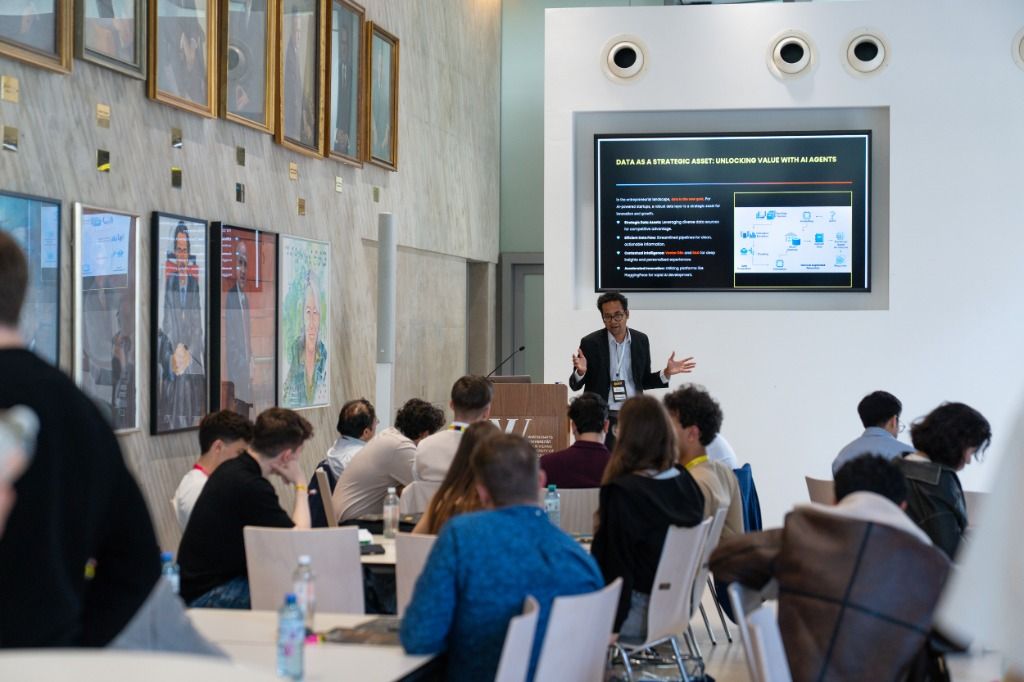
Data as a Strategic Asset
In the entrepreneurial landscape, data is the new gold. For AI-powered startups, a robust data layer is a strategic asset for innovation and growth — diverse data sources become a competitive advantage only when streamlined pipelines turn them into clean, actionable information. We discussed how vector databases and RAG (retrieval-augmented generation) deliver the contextual intelligence behind personalized experiences, and how platforms like HuggingFace accelerate AI development without building everything from scratch.
Orchestration: Making Agents Work Together
Efficient orchestration is the difference between a promising idea and a scalable business. We covered function calling for integrating agents with external business tools and APIs, MCP (Model Context Protocol) as the emerging standard for inter-agent communication and workflow coordination, and the continuous review and refinement cycles needed for robust, reliable AI solutions.
Strategic AI Models: Building the Brains for Your Vision
Choosing a model is a critical strategic decision that directly impacts a product's capabilities, cost-efficiency, and market fit. We compared the two key trade-offs founders face:
Open vs. Proprietary
Open-source models like Llama and Mistral offer flexibility, community support, and lower licensing costs. Proprietary models like GPT-4 and Claude deliver cutting-edge performance and dedicated support. The right answer depends on your resource availability and performance needs — not on what's trending.
SLMs vs. LLMs
Bigger isn't always better. Small Language Models are ideal for lean startups: faster inference and lower operational expenses. Large Language Models provide superior reasoning for complex problems and ambitious challenges. And for many startups, specialisation — fine-tuning for niche markets and tailored customer solutions — beats raw capability.
Infrastructure and Interfaces
Underneath it all sits infrastructure: GPUs (NVIDIA H100/A100) and TPUs as the computational engine, with a three-way trade-off between cloud (scalability and cost-efficiency for rapid growth), on-premise (maximum control, security, and data sovereignty), and local/edge deployment (privacy and low latency for specialized tasks).
And on top, the interface layer that determines adoption: multimodal inputs (text, image, audio, data), broad accessibility, citations for transparency, revisions for rapid iteration, and integration into the tools teams already use — CRM systems, project management platforms, Slack, and Teams. An agent that doesn't fit existing workflows doesn't get used.


An Interactive Session
To keep the session hands-on rather than a lecture, we embedded live Slido activities throughout the presentation. Participants assessed where their own startup or project stands with AI, ranked their biggest orchestration challenges, tested their instincts on which model type fits a lean startup, and gauged how ready they felt to integrate an AI agent into their venture. The level of participation exceeded my expectations — the Slido statistics showed a highly engaged audience throughout, which made the discussion richer for everyone in the room.
The Audience Made It Special
What stood out most was the audience itself: a room full of students, early-stage founders, and future entrepreneurs asking sharp, practical questions. Not "will AI replace us?" but "how do I actually build with this?" That curiosity and pragmatism is exactly what makes events like Entrepreneurship Avenue valuable — it connects people at the very start of their journey with the tools and thinking they need.
Thank You, Entrepreneurship Avenue
A sincere thank you to the Entrepreneurship Avenue team for the excellent organization, the warm hospitality, and the thoughtful personal touches after the workshop. It's a pleasure to support an initiative that inspires the next generation of European entrepreneurs.
AI agents are becoming the ultimate entrepreneurial tool. At OG Technologies EU, we help founders and enterprises not only envision that future but actively build it — if you attended the workshop and want to continue the conversation about agent architecture, data strategy, or AI for your startup, feel free to reach out.
Photos: Entrepreneurship Avenue
Frequently Asked Questions
What is the sense-think-act agent anatomy?
A practical framework for understanding AI agents: sensing (ingesting market, visual, sensor, and API data), thinking (knowledge bases, planning logic, LLM-powered analysis with feedback loops), and acting (automation, alerts, and CRM/ERP actions).
What is MCP in AI agent architecture?
Model Context Protocol — an emerging standard for connecting AI agents with external tools, data sources, and other agents, enabling orchestrated multi-agent workflows.
Should startups choose small or large language models?
It depends on the use case: SLMs offer faster inference and lower operational cost for lean startups, LLMs provide superior reasoning for complex problems — and specialization through fine-tuning often beats raw capability.
What is Entrepreneurship Avenue?
A European student-run startup conference hosted at WU Wien (Vienna University of Economics and Business), connecting founders, students, and innovators — the 2026 edition featured our AI Agent Architecture workshop.
Olvis Enrique Gil Ríos is the founder of OG Technologies EU, a Vienna-based consultancy helping enterprises and startups adopt AI, blockchain, and international standards.
#EntrepreneurshipAvenue #AIAgents #AIArchitecture #MCP #RAG #Startups #Entrepreneurship #WUVienna #OGTechnologies