Since 9 October 2025, every bank and payment service provider in the eurozone must let customers send SEPA instant payments — and must offer Verification of Payee (VoP): a real-time check that the name typed by the payer matches the name on the destination IBAN before the money moves. VoP comes from the Instant Payments Regulation (Regulation (EU) 2024/886, Article 5c), applies to both instant and standard SEPA credit transfers, and must be offered to the payer free of charge. If you have made a euro transfer recently, you have seen it — the "does this name match?" step is the regulation in action.
The Rollout Timeline
The IPR staggers obligations by geography and institution type. What applies when:
- 9 January 2025 — euro-area PSPs must receive instant payments.
- 9 October 2025 — euro-area PSPs must send instant payments and offer VoP. The EPC's Verification of Payee scheme rulebook, the interoperability backbone, entered into force on 5 October 2025.
- 9 January 2027 — PSPs in non-euro-area member states must receive instant payments.
- 9 July 2027 — non-euro-area PSPs must send instant payments and offer VoP.
- 9 April / 9 July 2027 — payment institutions and e-money institutions follow on their own later tracks, alongside their new right to direct participation in payment systems.
How the Check Works
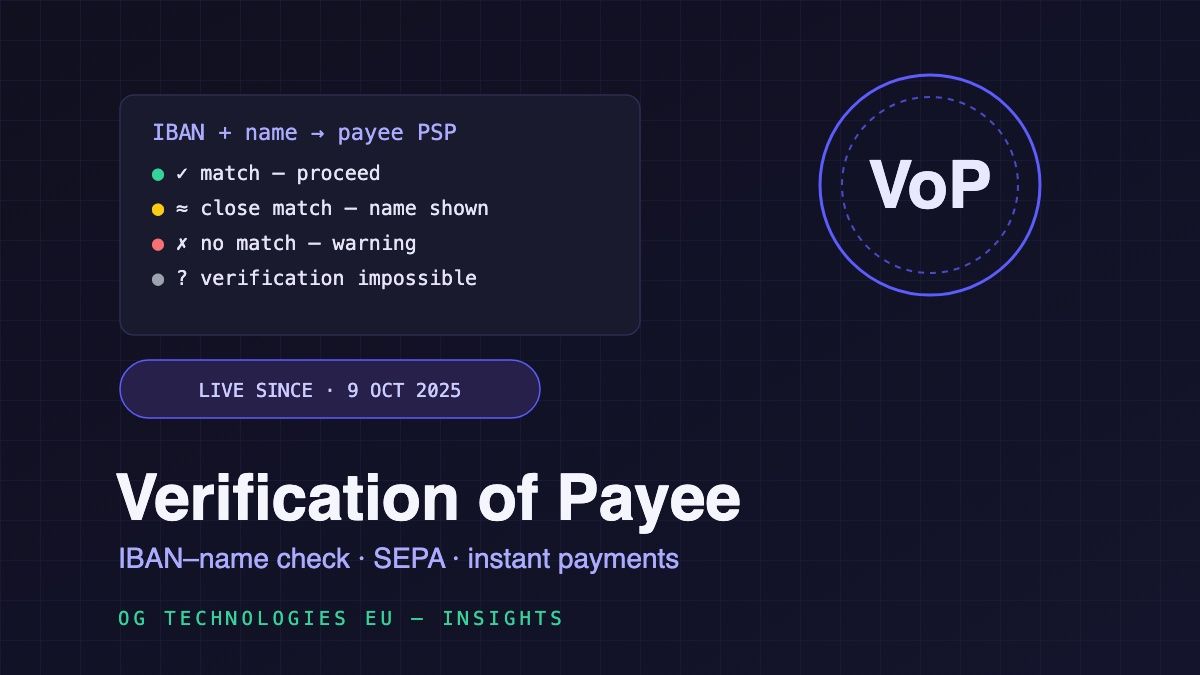
When the payer enters an IBAN and a beneficiary name, their PSP fires a verification request — through the EPC scheme or an interoperable routing mechanism — to the payee's PSP, which must respond within seconds. Four outcomes come back:
- Match — name and IBAN agree; the payer can proceed normally.
- Close match — near enough to suggest a typo; the PSP returns the payee's actual account name so the payer can confirm or correct it.
- No match — a warning that the name does not correspond to the IBAN. The payer can still send — but now explicitly at their own risk.
- Verification not possible — the check could not be performed (technical failure, unreachable payee PSP); the payer is warned and decides.
The check happens on the name–IBAN pair, not on the payment itself — it runs for standard credit transfers exactly as for instant ones, and it runs before authorization, which is what makes it a fraud control rather than a reconciliation tool.
The Liability Shift
VoP changes who carries the loss on misdirected payments. If the PSP warned the payer — no match, or verification impossible — and the payer proceeded anyway, the PSP is not liable for the misdirected funds. Conversely, a PSP that fails to perform the verification properly can be on the hook under the refund rules. For payers, the practical rule is simple: a no-match warning is the moment to stop — the check is the fraud filter, not a formality.
Scope Nuances Worth Knowing
- Both rails: VoP applies to SEPA Instant Credit Transfers and standard SEPA Credit Transfers — not only the instant rail that headlines the regulation.
- Bulk payments: PSPs must offer verification for batch file submissions too, but non-consumer payment service users (businesses) may opt out of VoP for their bulk files — a carve-out designed for payroll and supplier runs where name data is messy.
- Free for the payer: the verification service itself cannot be charged to the customer initiating the payment.
- Instant ≠ more expensive: a separate IPR rule caps instant-payment fees at the price of an equivalent standard transfer, removing the premium that suppressed adoption.
Why the EU Mandated It
The target is authorised push payment (APP) fraud — invoice redirection, CEO fraud, IBAN-spoofing scams where the victim authorizes a transfer to a criminal's account. Instant settlement made it worse: once sent, the money is gone in seconds. The model had already proven itself where it ran voluntarily: the Dutch IBAN-Name Check and the UK's Confirmation of Payee both cut misdirected-payment fraud substantially. The IPR takes that mechanism EU-wide and binds it to the instant-payment rollout so security lands with speed, not after it.
The Companion Change: Sanctions Screening
The same regulation quietly rewires sanctions compliance for instant payments. Screening every transaction in under ten seconds was unworkable, so Article 5d replaces per-transaction checks with a requirement to screen the customer list — at least daily — against EU targeted financial restrictive measures. Combined with VoP, the pattern is clear: controls move from the transaction to the account-holder verification layer.
Practical Implications
For PSPs the work is matching quality: name normalization, fuzzy matching against legal names, handling abbreviations and joint accounts, and keeping false-positive rates low enough that warnings stay credible. For corporates, the action is data hygiene — the beneficiary names in your ERP and payment files are now checked against bank-side records, so stale or informal names ("J. Smith" vs "Smith Holdings BV") generate warnings your AP team has to clear. Validate the IBAN and BIC before you send with our free IBAN Validator and BIC Validator, and check the payment file itself with the SEPA XML Validator. For the message-format side of the same payments modernization, see our ISO 20022 migration guide.
Frequently Asked Questions
Does VoP apply to standard credit transfers or only instant ones?
Both. The check is mandatory for SEPA Instant Credit Transfers and standard SEPA Credit Transfers alike — the instant-payment headline obscures the wider scope.
What does a "close match" result show?
The payee's PSP returns the actual account name associated with the IBAN, so the payer sees who the account really belongs to — e.g., "Smith Holdings BV" when they typed "Smith". The payer can then confirm or correct before sending.
Is my bank liable if I proceed after a no-match warning?
No — that is the point of the warning. If you were shown a no-match or a verification-impossible notice and sent the payment anyway, the liability for the misdirected funds sits with you. The PSP's exposure runs the other way: it must perform the check correctly.
Do batch payments have to be verified too?
The PSP must offer verification for bulk submissions, but non-consumer users — businesses running payroll or supplier files — can opt out for those batches. Consumer single payments have no opt-out.
When do non-euro countries get VoP?
On the non-euro track: receiving instant payments by 9 January 2027, sending plus VoP by 9 July 2027. Payment and e-money institutions have their own deadlines in April and July 2027.